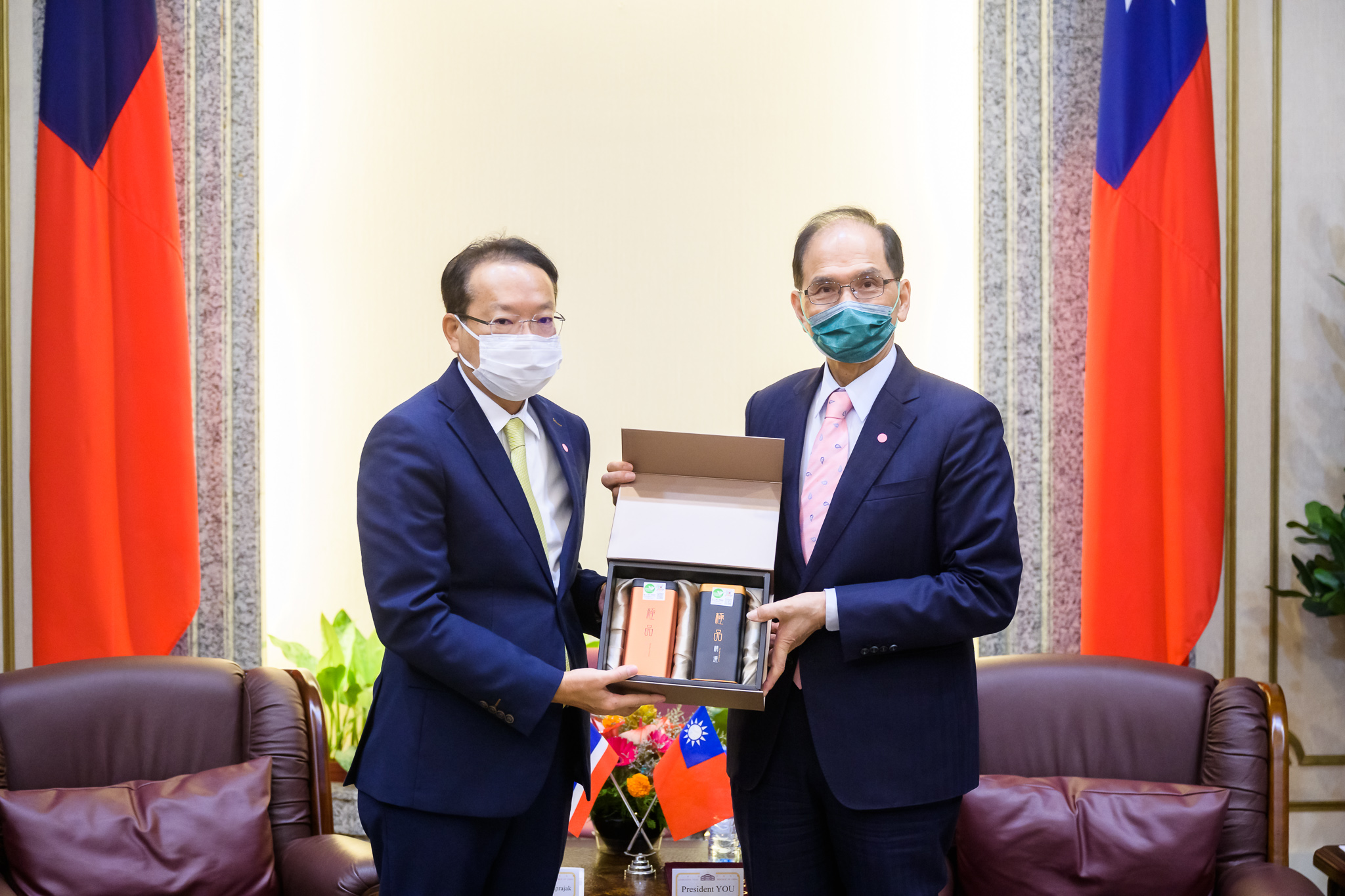
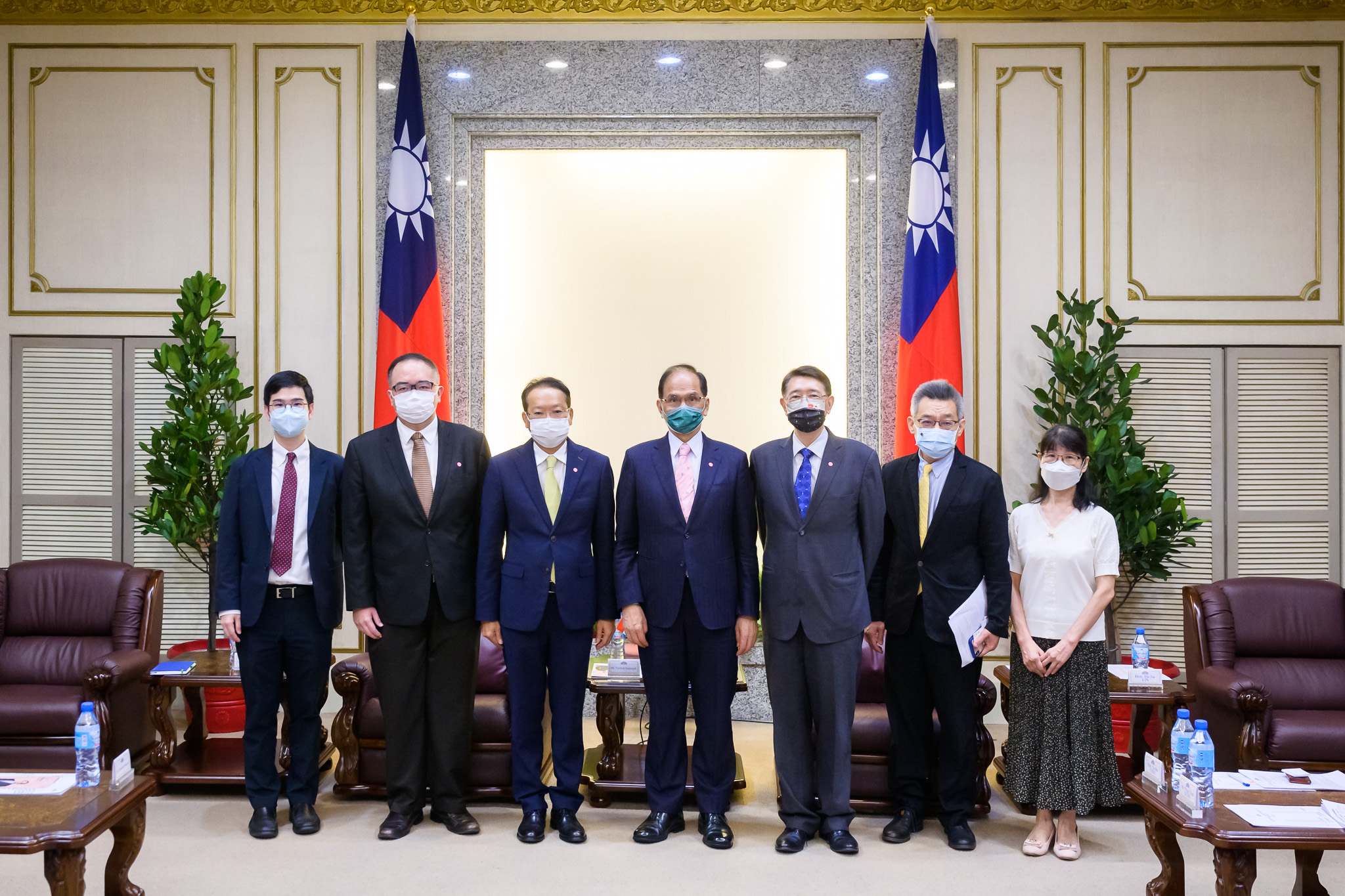
Legislative Yuan President You Si-kun receives Mr. Twekiat Janprajak, Executive Director of the Thailand Trade and Economic Office
President You: Closer cooperation needed to respond effectively to the rapidly changing global situation
Accompanied by Secretary General Lin Jih-jia, Consultant Chou Ya-shu, and Secretariat Director Kung Ping-chieh, Legislative Yuan President You Si-kun received head of the Thailand Trade and Economic Office Twekiat Janprajak and his delegation this morning. In remarks at the event, President You congratulated Executive Director Janprajak on taking up his new post. On behalf of the Legislative Yuan, President You welcomed Director Janprajak, stating that Taiwan and Thailand are both democracies and expressing his admiration for Thailand’s political and economic development.
President You continued by stating that while Taiwan and Thailand do not have diplomatic relations, they have close economic and trade exchanges. In particular, Thailand features heavily in President Tsai Ing-wen’s New Southbound Policy. He then expressed gratitude for how Thai expatriates in Taiwan have helped to develop the economy. President You also mentioned about Dr. Chuang Suo-hang, Taiwan’s newly appointed representative to Thailand, was his spokesperson when President You was Premier. Dr. Chaung also once served as a legislator. As both sides have appointed new representatives, Taiwan and Thailand have a unique opportunity to further develop their relationship.
President You stated that the current international situation was experiencing drastic change. In recent years, there were anti-extradition bill protests in Hong Kong and social movements in Thailand. This year, the Ukraine-Russia war has erupted. Since the source of threats in the Indo-Pacific region is the Chinese Communist Party, the US Indo-Pacific Strategy has gradually taken shape as a response. Thailand, countries in South Asia and Southeast Asia, and even Japan and the Republic of Korea border China. Since China became the world’s second-largest economy, it has become hegemonic and poses a threat to its neighbors. Therefore, Taiwan-Thailand relations are more important than ever and the two sides ought to pursue closer cooperation.
President You then analyzed with grave concern the essence of China’s various actions, demonstrating that the Chinese Communist Party (CCP) is self-contradictory. For example, during the Mao Zedong era, Confucius was criticized, but now that Confucian thinking is conducive to the party’s continued hold on power, Confucius Institutes are being established by China worldwide. The “Chinese dream” of “the great rejuvenation of the Chinese nation” proposed in 2013 aims at promoting China’s traditional expansionist political thinking, namely, “There cannot be two suns in the sky, nor two emperors on the Earth,” and “All land under heaven belongs to the King, and all people on the shores are subjects of the King.” For example, since the CCP began touting the Belt and Road Initiative in 2013, an expansionist policy continues to be seen. Successful artificial island construction in the South China Sea, the return of Hong Kong, the recent claim that the Taiwan Strait is not international waters, and a continuing circumnavigation of Taiwan by Chinese warplanes and warships all show China’s gradual external expansionism. If Taiwan is conquered, neighboring countries such as Myanmar, Vietnam, the Republic of Korea, and Japan will all be in danger.
In his remarks, Representative Janprajak thanked President You for taking the time to meet him. His previous post was in Singapore and he was pleased to have taken the position in Taiwan. He was fortunate to have the opportunity to work in Taiwan since he had previously been responsible for Taiwan affairs. He then mentioned the remarkable achievements of the Legislative Yuan, especially passing a bill that reduced the threshold for exercising civil rights to age 18. Thailand’s youth love freedom and democracy, he said, sharing that as they are interested in politics, they are the engine of Thailand’s democracy. He then said that parliamentary exchanges between Taiwan and Thailand have grown, and that the two nations enjoy close economic exchanges. There are more than 5,000 Taiwanese businesses in Thailand and 200,000 Taiwanese nationals. Taiwan’s representative office promotes visa-exemption treatment for Republic of China (Taiwan) passport holders. It is hoped that bilateral exchanges and mutual visits will continue to grow closer. He ended by praising Taiwan’s New Southbound Policy, which has been successful in related countries.
The two sides then exchanged opinions on the global situation, the Indo-Pacific Strategy, offshore wind power, local elections, electric vehicles, net-zero emissions policies, and other issues. The meeting concluded at 11:10 a.m. after an exchange of gifts and a group photo.