

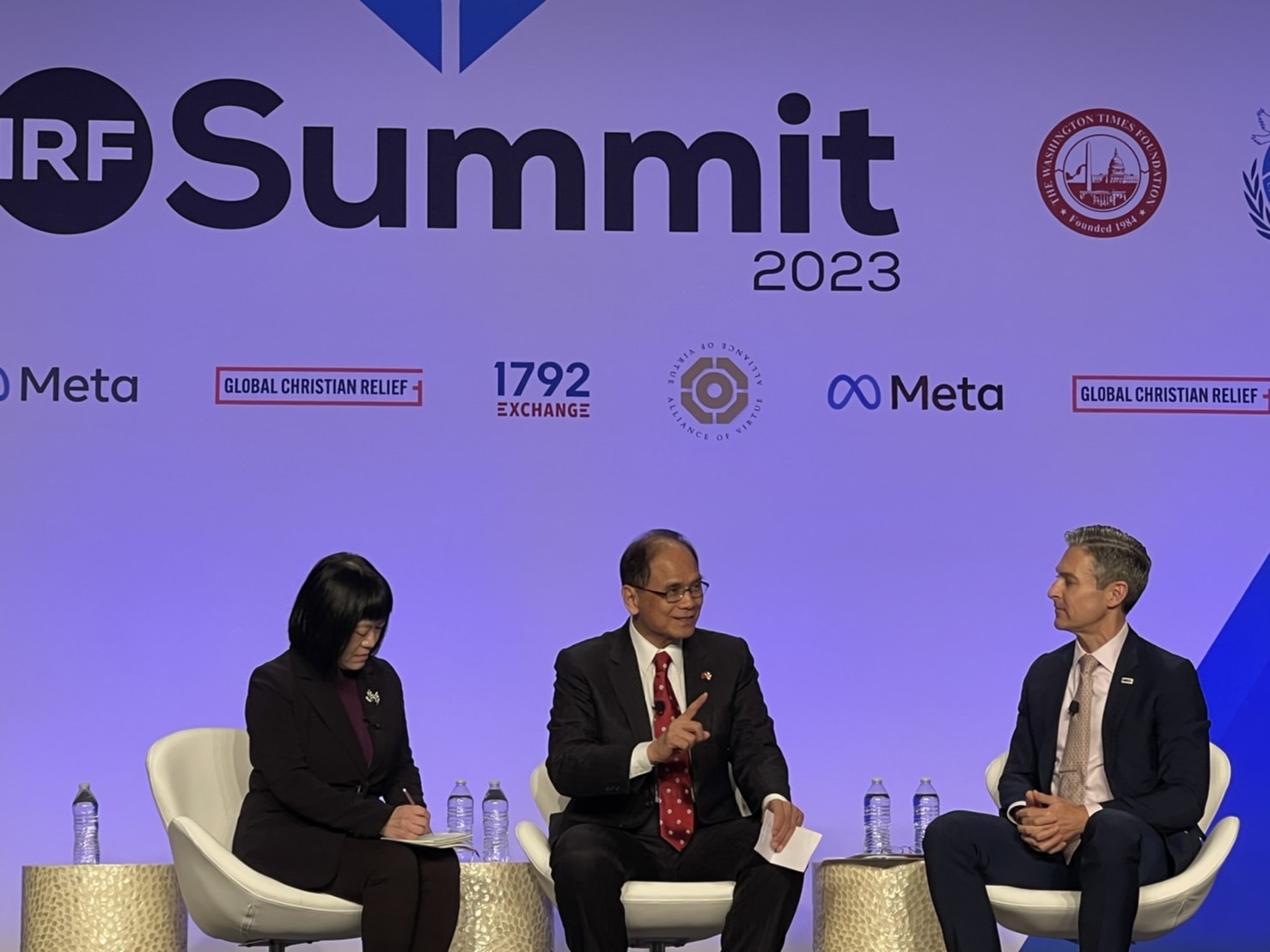
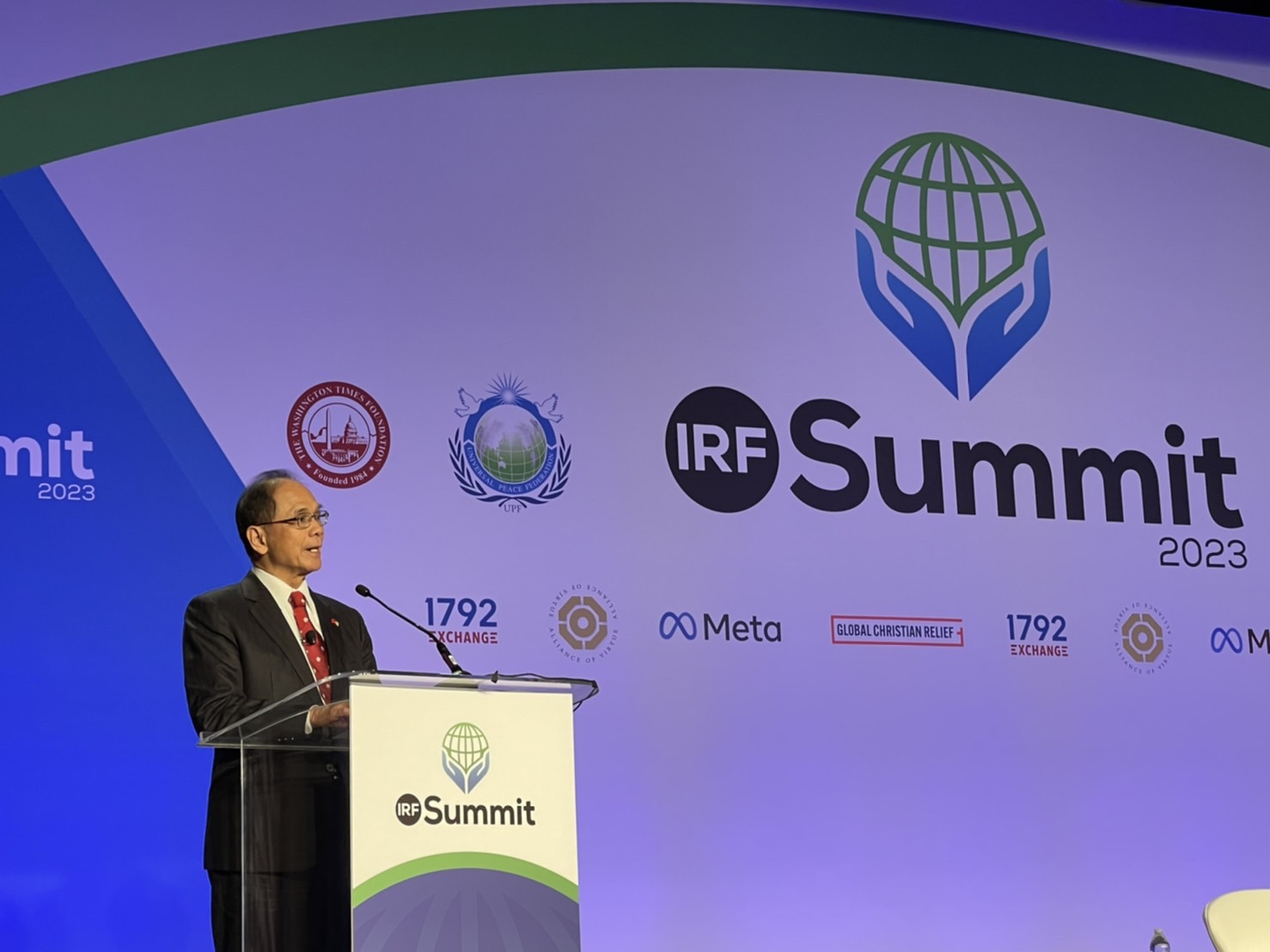
President's You's Remarks at the IRF Summit Born to be free; striving for human freedom
Born to be free; striving for human freedom
Remarks at the IRF Summit
You Si-kun
President of the Legislative Yuan
Republic of China (Taiwan)
International Religious Freedom Summit Co-chair Sam Brownback; Co-chair Katrina Lantos Swett; National Endowment for Democracy President Damon Wilson; distinguished guests; ladies and gentlemen: good morning!
Thanking the US for supporting Taiwan
It is an honor to address the International Religious Freedom Summit today as the President of the Legislative Yuan of the Republic of China (Taiwan). The IRF Summit has long kept watch on issues touching on international religious freedom. I want to express my utmost respect to your organization for fighting for freedom and human rights. On behalf of Taiwan’s legislature and 23 million people, I want to thank the United States for helping to maintain cross-strait peace over the past few decades, and for promoting Taiwan-US exchanges in the fields of economics, technology, and culture. I also want to thank the US for its attention and assistance in the past as the people of Taiwan pursued democracy.
The origin of Austronesian peoples
Taiwan is a land of beautiful mountains and rivers; it is blessed with a diversity of habitats. Thousands of years ago, Austronesian people living on Taiwan set out in dugout canoes to explore the world. In the Pulitzer Prize-winning book Guns, Germs, and Steel, author Jared Diamond, a member of the National Academy of Sciences, attests that the ancestors of over 200 million residents of places as far-flung as Madagascar in the west to Easter Island in the east have their origin in Taiwan.
Connecting to the world in the Age of Exploration
Because of its strategic location, over the past 400 years, Taiwan has been occupied by the Dutch, the Spanish, Ming Dynasty ruler Zheng Chenggong, the Qing Dynasty, and Japan. In 1624, during the Age of Exploration, the Dutch built forts in southern Taiwan, while two years later, the Spanish occupied the north. Taiwan has played a key role in world history, while the world has been involved in the history of Taiwan.
A beacon of democracy for Chinese-speaking peoples
Although Taiwan was a colony for 399 years and was much repressed, the people of Taiwan remained courageous and held on to their ideals. They were unafraid of sacrifice, or of paying the price in an attempt to become masters of their own destiny. Although after World War II, Taiwan suffered the world’s longest period of martial law and authoritarian rule, such travails never caused the people to abandon their pursuit of freedom and democracy. In 1986, the end of the ban on forming political parties pushed Chiang Ching-kuo to announce an end to martial law. Following this, the collective efforts of the people of Taiwan led to regular elections for the national parliament, the direct election of the president, and the peaceful transfer of power between political parties, which has now occurred three times. Taiwan thus awoke as does a chrysalis from a long slumber, metamorphosing into a nation that defends religious liberty and human rights. Taiwan has long been called the Butterfly Kingdom for the preponderance of these insects on the island. Like a butterfly, Taiwan flaps its wings in the democratic camp, and shows, in a butterfly effect, that democracy can indeed flourish in Chinese-speaking regions. It has overthrown myths propagated by certain ethnic Chinese leaders, who maintained that human rights and democracy are imports from the West, and unsuitable for Asian nations. Taiwan has shown that democracy, born of the West, can indeed flourish in Chinese-speaking regions.
A leader in international freedom and democracy indices
As its democratic system has developed, Taiwan has proactively protected religious freedom and encouraged religions’ healthy development. A 2014 report by the Pew Research Center ranked Taiwan second among 232 nations and areas in its Religious Diversity Index. The Economist Intelligence Unit’s Democracy Index released last February had Taiwan ranked eighth globally and first in Asia. In its 2022 report, Freedom House’s Freedom in the World report gave Taiwan a score of 94, second only to Japan in Asia and tied with Iceland at 17th globally. For religious freedom, Taiwan earned a full score of 4.
Darkness persists across the world
Although like me, all of you live in lands where there is respect for different faiths and where freedom, democracy, and human rights are defended, we all know that many people around the globe are repressed, denied freedom of choice, and live in fear for their lives; they even lack the basic freedom to live for others. Examples of those living in darkness include the Muslim Rohingya in Myanmar and Christians in North Korea. And in China, there is a comprehensive, systematic repression of religion.
The Chinese Communist Party’s all-out assault on religion
In 2014, 1,200 crosses were forcibly taken down in Zhejiang Province. In 2018, over 20 million Christians faced repression in China. In 2020, Xi Jinping announced the Sinicization of Christianity in the nation’s latest five-year plan. In just four months that same year, crosses were ripped down off of 250 churches in Anhui Province alone. Countless people’s Bibles were confiscated, while the sayings of Xi Jinping were made to replace the Ten Commandments. For the past 60 years in Tibet, countless Tibetans have been arrested and imprisoned for honoring the Dalai Lama. The Uighur people have also been seriously repressed for practicing Islam. In provinces with large Muslim populations like Inner Mongolia, Henan, and Ningxia, mosques have been razed, while a further three mosques have been closed in Yunnan. The Chinese Communist Party’s attempts to extinguish the mother tongues, cultures, and faiths of different groups cannot be enumerated.
The expansionary nature of CCP rule
Aside from its outrageous suppression of religion, the CCP’s most dangerous aspect is the nature of its rule. Since China’s economic rise, it has transitioned from a position of criticizing Confucius taken in the 1970s to lauding Confucius today. China has established over 500 Confucius Institutes across the world. Since taking power, Xi Jinping has overturned Deng Xiaoping’s position of having China keep a low profile as well as Hu Jintao’s notion of a peaceful rise. He has instead proffered the “China dream” and expressed a desire for China and the US to jointly rule the Pacific Ocean. Moreover, he has engaged in wolf-warrior diplomacy all over the world, promoted the Belt and Road Initiative, militarized the South China Sea, and ended the “one country, two systems” governance of Hong Kong. This has shown that the CCP is not only totalitarian by nature, but seeks to realize the traditional Confucian notion that “There is only one sun in the heavens, and only one king on earth,” and the traditional political thinking that “All land under heaven belongs to the emperor, and all the people living there are subjects of the emperor.”
A democratic rise is the only guarantor of peace
In 2006, speaking at the Heritage Foundation, I pointed out that China’s peaceful rise would not necessarily bring peace. Only a democratic rise would guarantee peace. I called on the world to understand the true nature of the Chinese Communist regime and of “red infiltration.” Xi Jinping’s reappointment last year shows that China remains a feudal regime, albeit with greater control. It is lamentable that today, sixteen years later, the people of China remain locked outside a world of freedom, democracy, and human rights.
A collective interest in religious freedom in China
Freedom of religion is the basis of human rights and is at the core of democratic values. We strongly believe that the people of China should breathe free air, and we ask that friends around the world take a collective interest in democratic development and religious freedom in China. For hundreds of years, the people of Taiwan have lived for freedom. We will continue to press forward for liberty. I want to thank all of you for your efforts to defend religious freedom. May you all enjoy good health and happiness.
Thank you.

Remarks at the IRF Summit
You Si-kun
President of the Legislative Yuan
Republic of China (Taiwan)
International Religious Freedom Summit Co-chair Sam Brownback; Co-chair Katrina Lantos Swett; National Endowment for Democracy President Damon Wilson; distinguished guests; ladies and gentlemen: good morning!
Thanking the US for supporting Taiwan
It is an honor to address the International Religious Freedom Summit today as the President of the Legislative Yuan of the Republic of China (Taiwan). The IRF Summit has long kept watch on issues touching on international religious freedom. I want to express my utmost respect to your organization for fighting for freedom and human rights. On behalf of Taiwan’s legislature and 23 million people, I want to thank the United States for helping to maintain cross-strait peace over the past few decades, and for promoting Taiwan-US exchanges in the fields of economics, technology, and culture. I also want to thank the US for its attention and assistance in the past as the people of Taiwan pursued democracy.
The origin of Austronesian peoples
Taiwan is a land of beautiful mountains and rivers; it is blessed with a diversity of habitats. Thousands of years ago, Austronesian people living on Taiwan set out in dugout canoes to explore the world. In the Pulitzer Prize-winning book Guns, Germs, and Steel, author Jared Diamond, a member of the National Academy of Sciences, attests that the ancestors of over 200 million residents of places as far-flung as Madagascar in the west to Easter Island in the east have their origin in Taiwan.
Connecting to the world in the Age of Exploration
Because of its strategic location, over the past 400 years, Taiwan has been occupied by the Dutch, the Spanish, Ming Dynasty ruler Zheng Chenggong, the Qing Dynasty, and Japan. In 1624, during the Age of Exploration, the Dutch built forts in southern Taiwan, while two years later, the Spanish occupied the north. Taiwan has played a key role in world history, while the world has been involved in the history of Taiwan.
A beacon of democracy for Chinese-speaking peoples
Although Taiwan was a colony for 399 years and was much repressed, the people of Taiwan remained courageous and held on to their ideals. They were unafraid of sacrifice, or of paying the price in an attempt to become masters of their own destiny. Although after World War II, Taiwan suffered the world’s longest period of martial law and authoritarian rule, such travails never caused the people to abandon their pursuit of freedom and democracy. In 1986, the end of the ban on forming political parties pushed Chiang Ching-kuo to announce an end to martial law. Following this, the collective efforts of the people of Taiwan led to regular elections for the national parliament, the direct election of the president, and the peaceful transfer of power between political parties, which has now occurred three times. Taiwan thus awoke as does a chrysalis from a long slumber, metamorphosing into a nation that defends religious liberty and human rights. Taiwan has long been called the Butterfly Kingdom for the preponderance of these insects on the island. Like a butterfly, Taiwan flaps its wings in the democratic camp, and shows, in a butterfly effect, that democracy can indeed flourish in Chinese-speaking regions. It has overthrown myths propagated by certain ethnic Chinese leaders, who maintained that human rights and democracy are imports from the West, and unsuitable for Asian nations. Taiwan has shown that democracy, born of the West, can indeed flourish in Chinese-speaking regions.
A leader in international freedom and democracy indices
As its democratic system has developed, Taiwan has proactively protected religious freedom and encouraged religions’ healthy development. A 2014 report by the Pew Research Center ranked Taiwan second among 232 nations and areas in its Religious Diversity Index. The Economist Intelligence Unit’s Democracy Index released last February had Taiwan ranked eighth globally and first in Asia. In its 2022 report, Freedom House’s Freedom in the World report gave Taiwan a score of 94, second only to Japan in Asia and tied with Iceland at 17th globally. For religious freedom, Taiwan earned a full score of 4.
Darkness persists across the world
Although like me, all of you live in lands where there is respect for different faiths and where freedom, democracy, and human rights are defended, we all know that many people around the globe are repressed, denied freedom of choice, and live in fear for their lives; they even lack the basic freedom to live for others. Examples of those living in darkness include the Muslim Rohingya in Myanmar and Christians in North Korea. And in China, there is a comprehensive, systematic repression of religion.
The Chinese Communist Party’s all-out assault on religion
In 2014, 1,200 crosses were forcibly taken down in Zhejiang Province. In 2018, over 20 million Christians faced repression in China. In 2020, Xi Jinping announced the Sinicization of Christianity in the nation’s latest five-year plan. In just four months that same year, crosses were ripped down off of 250 churches in Anhui Province alone. Countless people’s Bibles were confiscated, while the sayings of Xi Jinping were made to replace the Ten Commandments. For the past 60 years in Tibet, countless Tibetans have been arrested and imprisoned for honoring the Dalai Lama. The Uighur people have also been seriously repressed for practicing Islam. In provinces with large Muslim populations like Inner Mongolia, Henan, and Ningxia, mosques have been razed, while a further three mosques have been closed in Yunnan. The Chinese Communist Party’s attempts to extinguish the mother tongues, cultures, and faiths of different groups cannot be enumerated.
The expansionary nature of CCP rule
Aside from its outrageous suppression of religion, the CCP’s most dangerous aspect is the nature of its rule. Since China’s economic rise, it has transitioned from a position of criticizing Confucius taken in the 1970s to lauding Confucius today. China has established over 500 Confucius Institutes across the world. Since taking power, Xi Jinping has overturned Deng Xiaoping’s position of having China keep a low profile as well as Hu Jintao’s notion of a peaceful rise. He has instead proffered the “China dream” and expressed a desire for China and the US to jointly rule the Pacific Ocean. Moreover, he has engaged in wolf-warrior diplomacy all over the world, promoted the Belt and Road Initiative, militarized the South China Sea, and ended the “one country, two systems” governance of Hong Kong. This has shown that the CCP is not only totalitarian by nature, but seeks to realize the traditional Confucian notion that “There is only one sun in the heavens, and only one king on earth,” and the traditional political thinking that “All land under heaven belongs to the emperor, and all the people living there are subjects of the emperor.”
A democratic rise is the only guarantor of peace
In 2006, speaking at the Heritage Foundation, I pointed out that China’s peaceful rise would not necessarily bring peace. Only a democratic rise would guarantee peace. I called on the world to understand the true nature of the Chinese Communist regime and of “red infiltration.” Xi Jinping’s reappointment last year shows that China remains a feudal regime, albeit with greater control. It is lamentable that today, sixteen years later, the people of China remain locked outside a world of freedom, democracy, and human rights.
A collective interest in religious freedom in China
Freedom of religion is the basis of human rights and is at the core of democratic values. We strongly believe that the people of China should breathe free air, and we ask that friends around the world take a collective interest in democratic development and religious freedom in China. For hundreds of years, the people of Taiwan have lived for freedom. We will continue to press forward for liberty. I want to thank all of you for your efforts to defend religious freedom. May you all enjoy good health and happiness.
Thank you.