

Deputy Secretary General Chang Yu-Jung of the Legislative Yuan receives delegation of state legislative leaders from the Midwestern United States
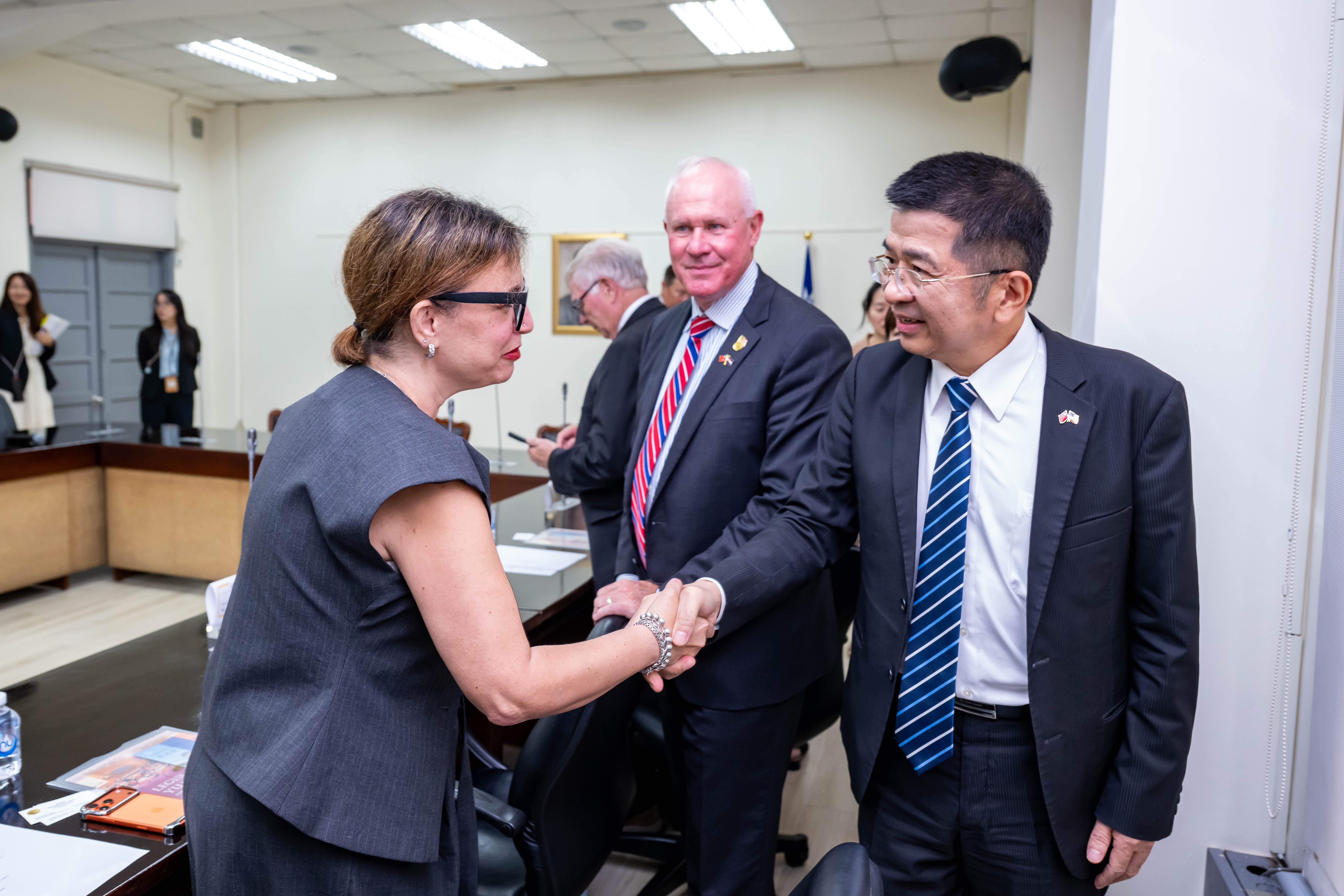
On the morning of October 29, Deputy Secretary General Dr. Chang Yu-Jung (張裕榮) of the Legislative Yuan received a ten-member delegation of state legislative leaders from the Midwestern United States.
Deputy Secretary General Chang opened the meeting by welcoming the U.S. Midwestern state legislative leaders to Taiwan on behalf of the Legislative Yuan and its President Daniel K.Y. Han (韓國瑜). He emphasized that the delegation members have long been committed to legislation and public service, serving as vital pillars of the U.S. democratic system. He specifically mentioned that President Han was unable to attend due to official duties and conveyed President Han’s sincere greetings and welcome.
Deputy Secretary General Chang furthered noted that the U.S. Midwestern region, with its vast territory and abundant resources, has substantial strength in the aerospace, agriculture, energy, and manufacturing sectors, which are highly complementary to Taiwan’s economic structure. He elaborated with several examples: Colorado is proactively leveraging Taiwan’s strengths in the semiconductor industry to upgrade its aerospace industry; Kansas became Taiwan’s third-largest source of agricultural imports in 2024; Missouri is a key hub for collaboration between the Taiwanese company GlobalWafers and the U.S. company GlobalFoundries, which is conducive to enhancing the resilience of bilateral supply chains; and North Dakota is not only a critical producer of U.S. crude oil and grain but also home to Microsoft’s second-largest facility. These examples, he said, demonstrate the Midwestern region’s strong development potential.
Additionally, Deputy Secretary General Chang stated that the Legislative Yuan USA Caucus was established following the commencement of the 11th Legislative Yuan in February 2024, with Vice President Dr. Johnny C. Chiang (江啟臣) serving as honorary president and one senior legislator from each of the Kuomintang (KMT) and Democratic Progressive Party (DPP) serving as co-chairs. To date, 72 legislators have joined, making it a significant cross-partisan platform for advancing parliamentary diplomacy, demonstrating the broad cross-party consensus within the Legislative Yuan to deepen Taiwan-US relations. Deputy Secretary General Chang also noted that, in addition to exchanges at the federal level, the Legislative Yuan has proactively facilitated collaboration with individual U.S. states. To date, he said, 23 states and Guam have established offices in Taiwan, including Missouri. He expressed the hope that more Midwestern states will set up offices in Taiwan to extend Taiwan-US relations from the central to the local level, thereby deepening diverse bilateral ties and promoting shared prosperity. Finally, Deputy Secretary General Chang encouraged the delegation members to visit night markets and various tourist attractions to experience Taiwan’s multi-faceted culture and warm hospitality, hoping that they would take home wonderful memories.
Head of the U.S. Midwestern state legislative delegation and President Pro Tempore of the Colorado Senate, Dafna Michaelson Jenet, first expressed appreciation for the warm hospitality of Deputy Secretary General Chang. She noted that the delegation members came from different states and represented their respective constituencies, expressing great pleasure in engaging in friendly exchanges with the Legislative Yuan. President Pro Tempore Jenet further stated that during the visit in Taiwan, the delegation had in-depth and fruitful discussions with Taiwanese government agencies on trade, education, and healthcare. She believed that continued advancement of Taiwan-US collaboration is essential. President Pro Tempore Jenet also mentioned that Taiwanese people’s warmth and friendliness had left a deep impression on the delegation, who looked forward to learning more about Taiwan and experiencing its local culture. Through diverse forms of interactions, she said, the delegation hoped to gain a more comprehensive understanding and appreciation of this beautiful country.






Subsequently, Deputy Secretary General Chang and the delegation members engaged in extensive discussions on topics including economic and trade cooperation, social security, climate change, AI applications, and energy in a cordial and friendly atmosphere. The meeting lasted approximately 40 minutes and concluded with an exchange of commemorative gifts and a group photo.


Deputy Secretary General Chang opened the meeting by welcoming the U.S. Midwestern state legislative leaders to Taiwan on behalf of the Legislative Yuan and its President Daniel K.Y. Han (韓國瑜). He emphasized that the delegation members have long been committed to legislation and public service, serving as vital pillars of the U.S. democratic system. He specifically mentioned that President Han was unable to attend due to official duties and conveyed President Han’s sincere greetings and welcome.
Deputy Secretary General Chang furthered noted that the U.S. Midwestern region, with its vast territory and abundant resources, has substantial strength in the aerospace, agriculture, energy, and manufacturing sectors, which are highly complementary to Taiwan’s economic structure. He elaborated with several examples: Colorado is proactively leveraging Taiwan’s strengths in the semiconductor industry to upgrade its aerospace industry; Kansas became Taiwan’s third-largest source of agricultural imports in 2024; Missouri is a key hub for collaboration between the Taiwanese company GlobalWafers and the U.S. company GlobalFoundries, which is conducive to enhancing the resilience of bilateral supply chains; and North Dakota is not only a critical producer of U.S. crude oil and grain but also home to Microsoft’s second-largest facility. These examples, he said, demonstrate the Midwestern region’s strong development potential.
Additionally, Deputy Secretary General Chang stated that the Legislative Yuan USA Caucus was established following the commencement of the 11th Legislative Yuan in February 2024, with Vice President Dr. Johnny C. Chiang (江啟臣) serving as honorary president and one senior legislator from each of the Kuomintang (KMT) and Democratic Progressive Party (DPP) serving as co-chairs. To date, 72 legislators have joined, making it a significant cross-partisan platform for advancing parliamentary diplomacy, demonstrating the broad cross-party consensus within the Legislative Yuan to deepen Taiwan-US relations. Deputy Secretary General Chang also noted that, in addition to exchanges at the federal level, the Legislative Yuan has proactively facilitated collaboration with individual U.S. states. To date, he said, 23 states and Guam have established offices in Taiwan, including Missouri. He expressed the hope that more Midwestern states will set up offices in Taiwan to extend Taiwan-US relations from the central to the local level, thereby deepening diverse bilateral ties and promoting shared prosperity. Finally, Deputy Secretary General Chang encouraged the delegation members to visit night markets and various tourist attractions to experience Taiwan’s multi-faceted culture and warm hospitality, hoping that they would take home wonderful memories.
Head of the U.S. Midwestern state legislative delegation and President Pro Tempore of the Colorado Senate, Dafna Michaelson Jenet, first expressed appreciation for the warm hospitality of Deputy Secretary General Chang. She noted that the delegation members came from different states and represented their respective constituencies, expressing great pleasure in engaging in friendly exchanges with the Legislative Yuan. President Pro Tempore Jenet further stated that during the visit in Taiwan, the delegation had in-depth and fruitful discussions with Taiwanese government agencies on trade, education, and healthcare. She believed that continued advancement of Taiwan-US collaboration is essential. President Pro Tempore Jenet also mentioned that Taiwanese people’s warmth and friendliness had left a deep impression on the delegation, who looked forward to learning more about Taiwan and experiencing its local culture. Through diverse forms of interactions, she said, the delegation hoped to gain a more comprehensive understanding and appreciation of this beautiful country.
Subsequently, Deputy Secretary General Chang and the delegation members engaged in extensive discussions on topics including economic and trade cooperation, social security, climate change, AI applications, and energy in a cordial and friendly atmosphere. The meeting lasted approximately 40 minutes and concluded with an exchange of commemorative gifts and a group photo.