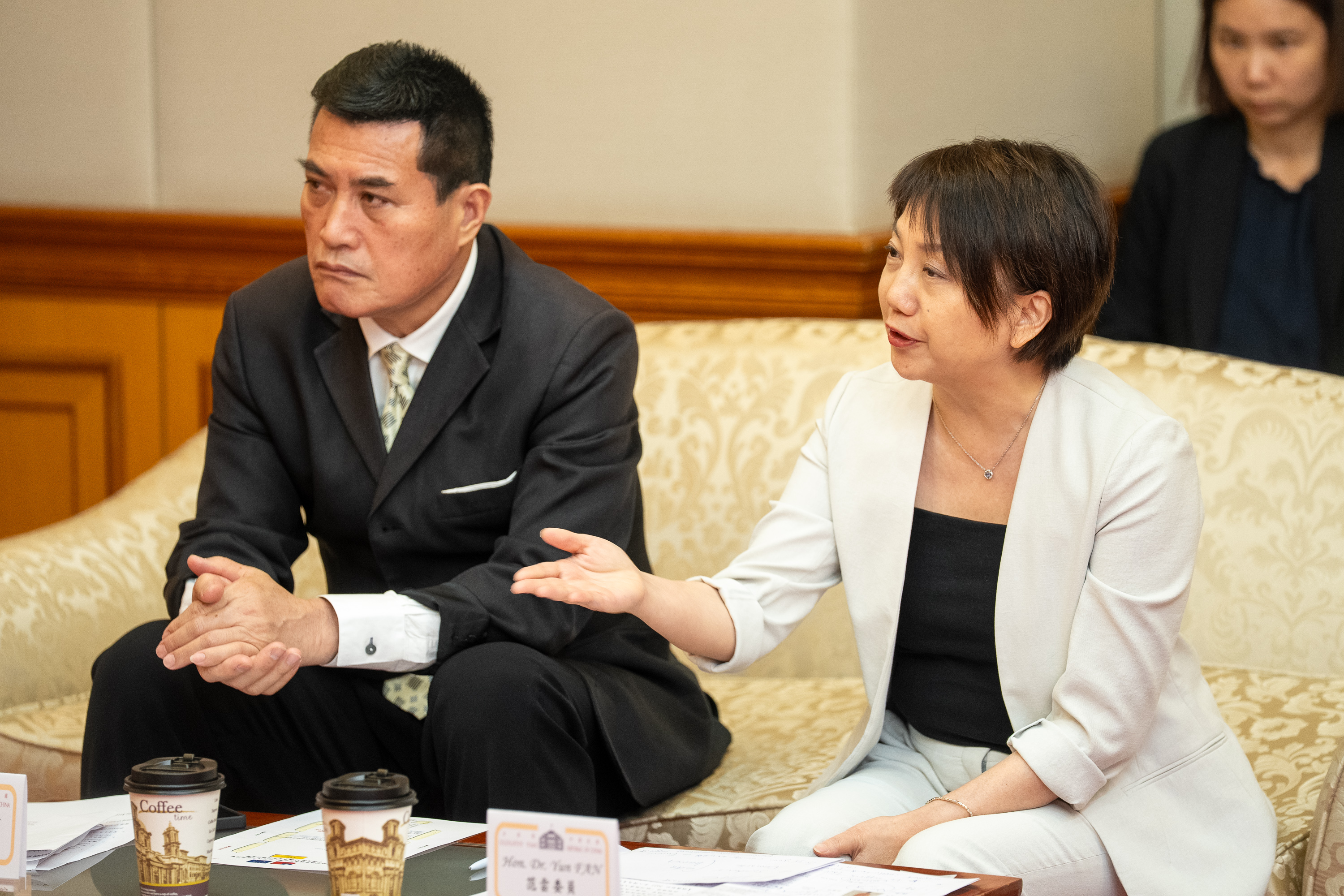
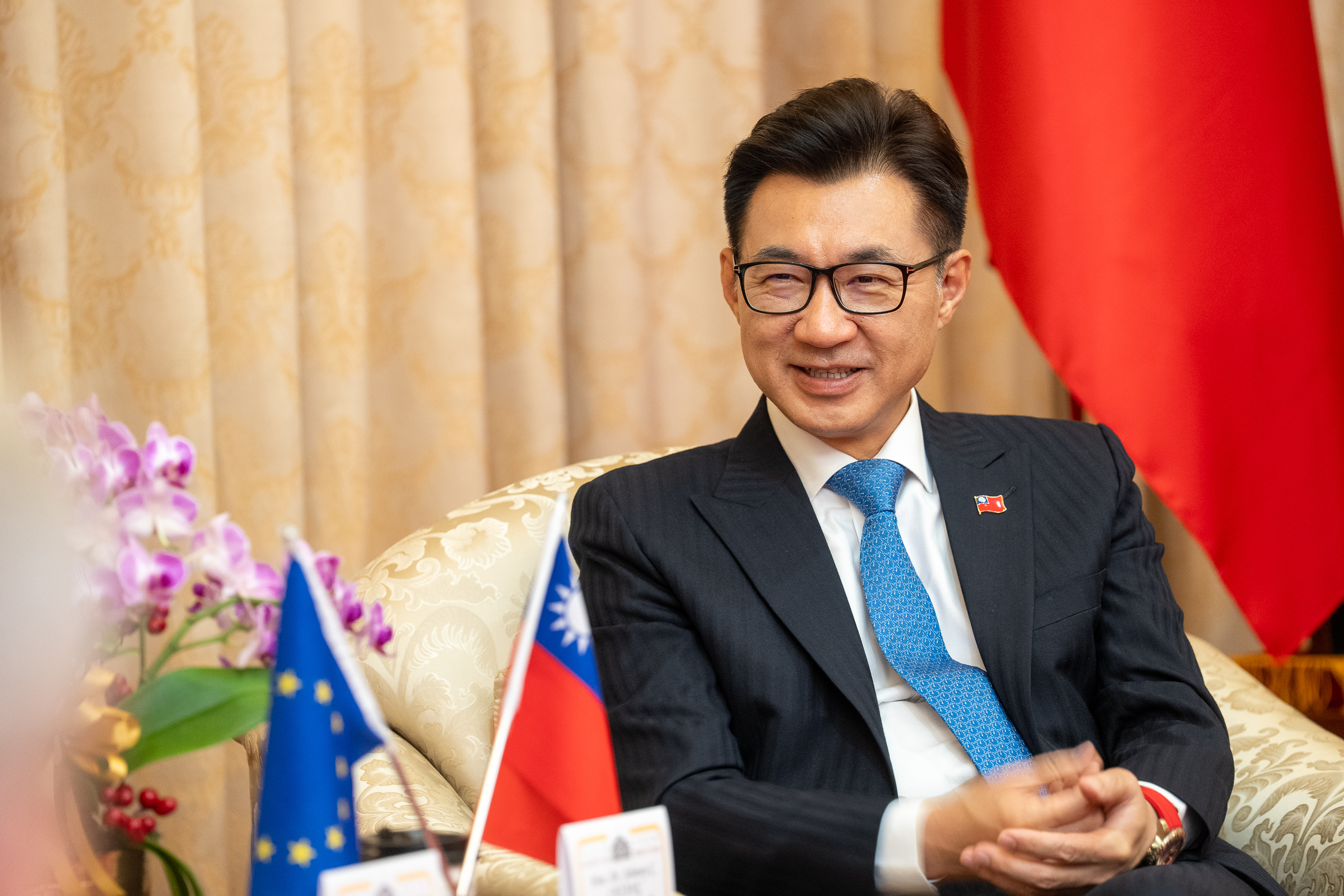
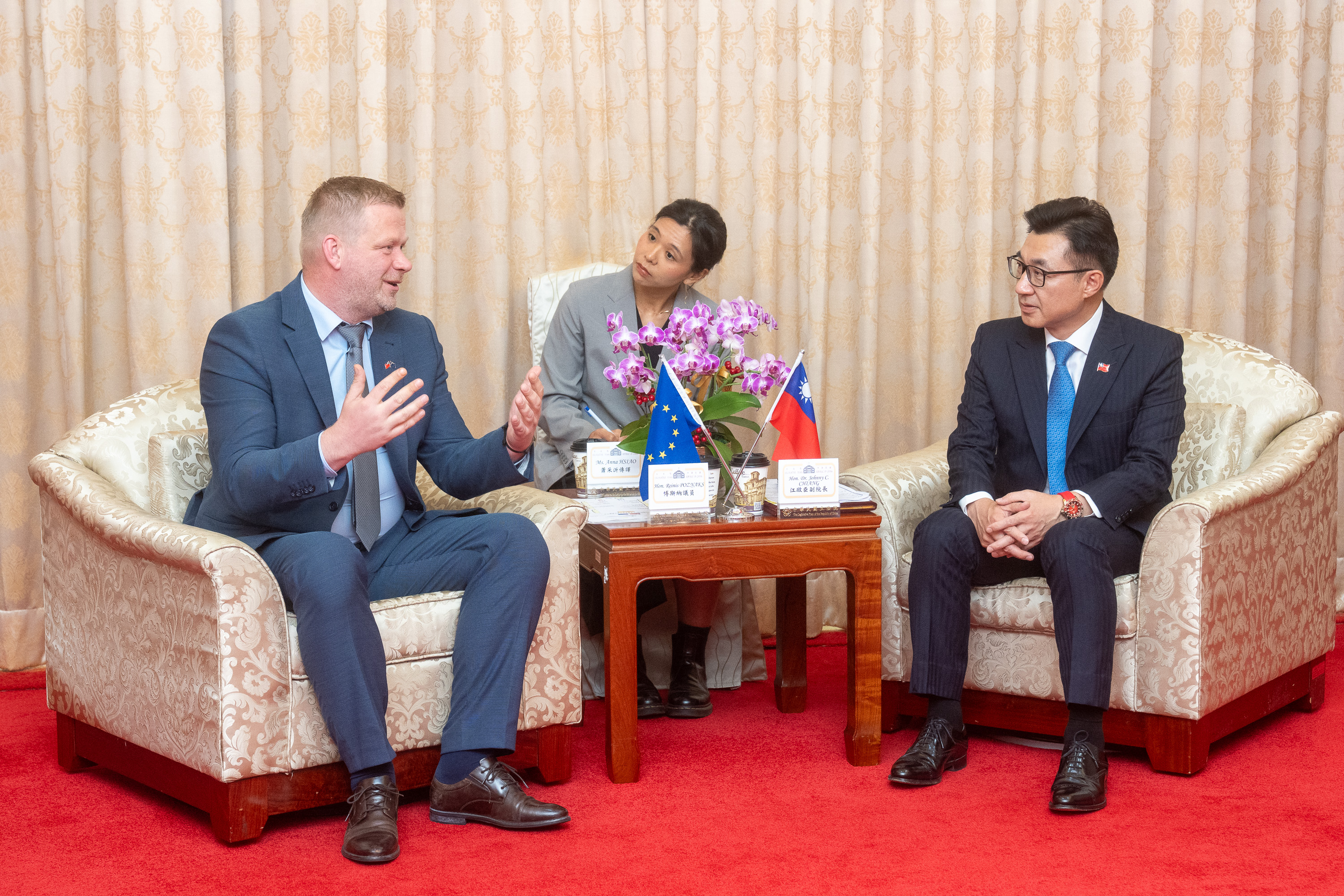
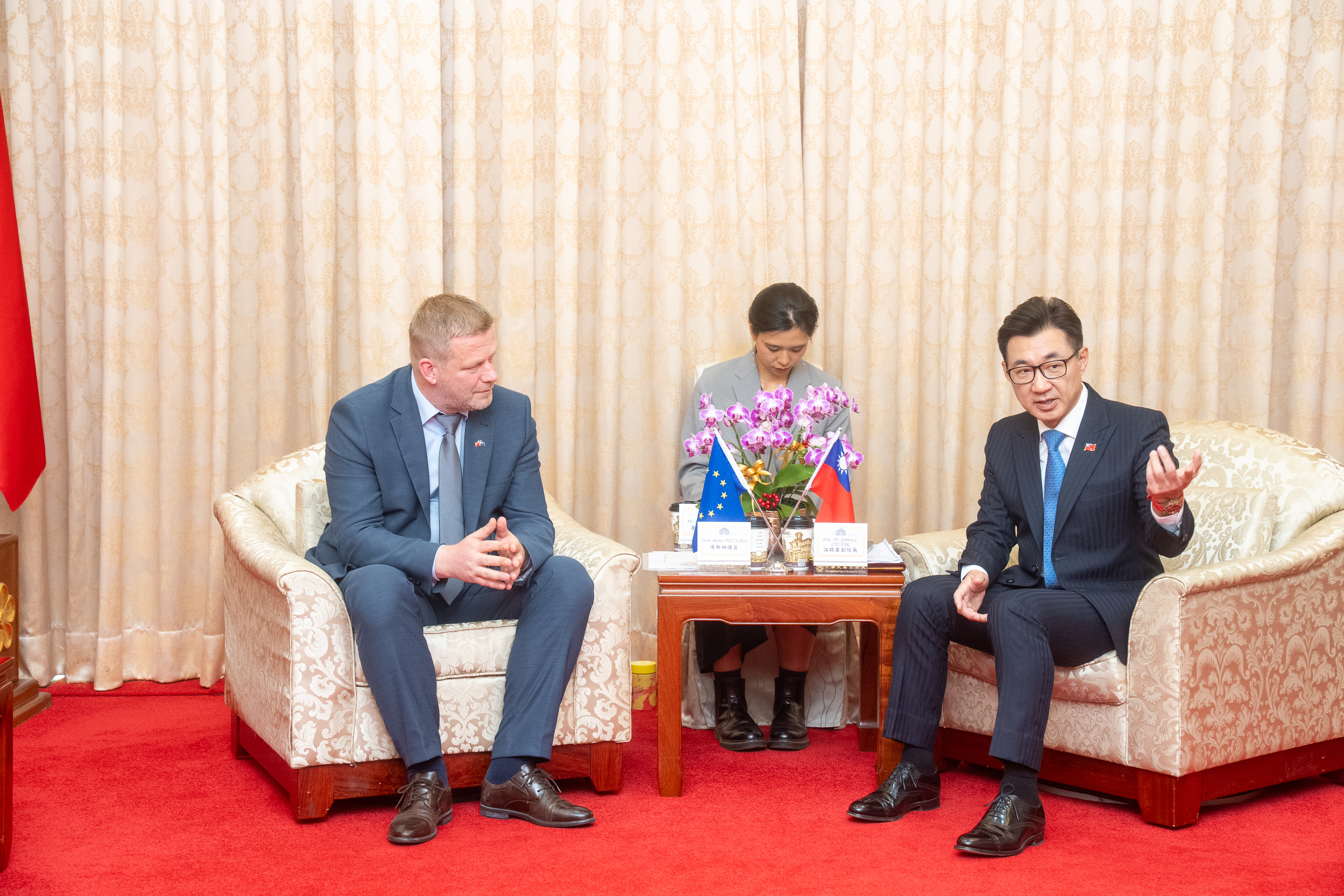
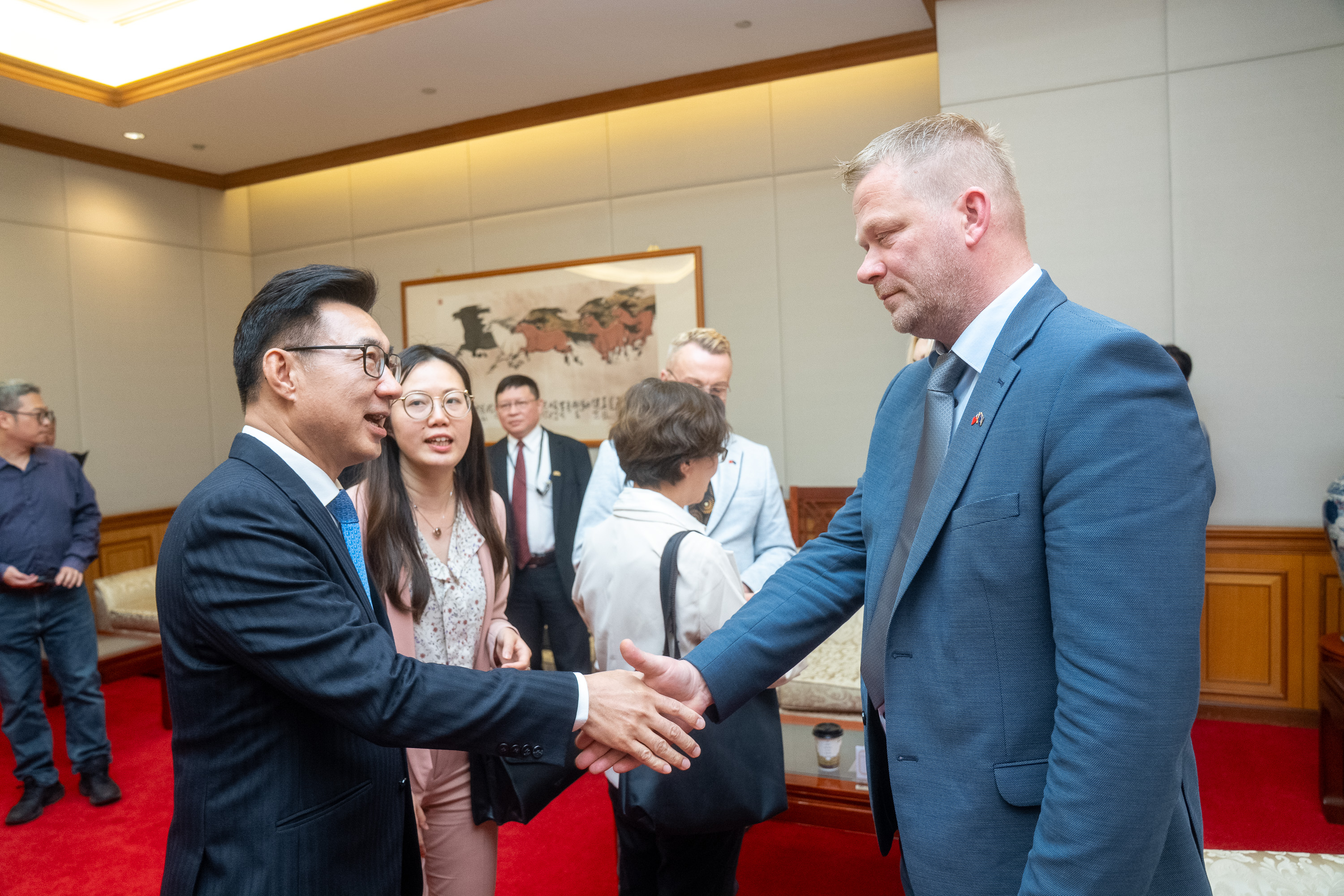
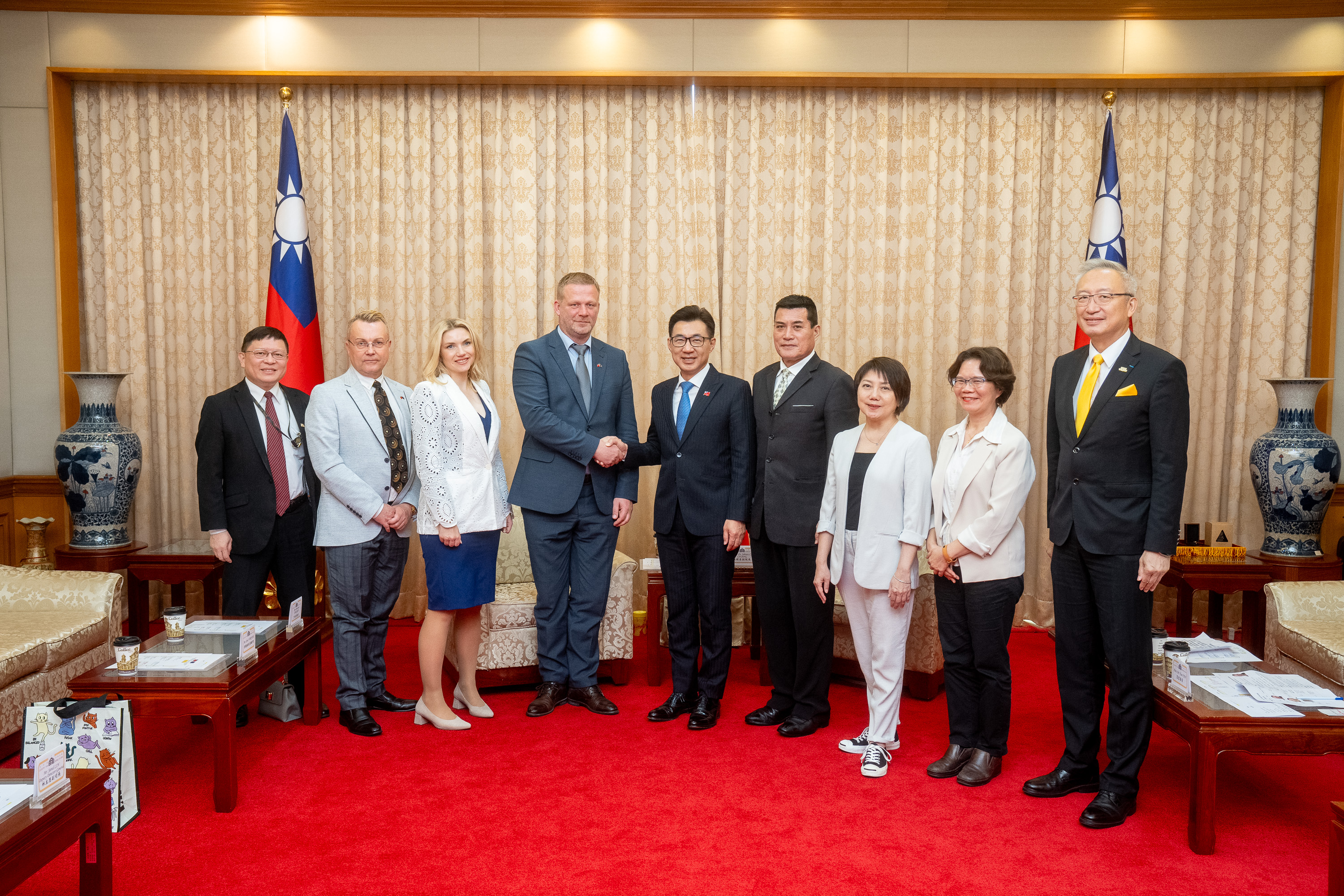
On the afternoon of May 28, Vice President of the Legislative Yuan Dr. Johnny C. Chiang received a three-member delegation from the European Parliament. He was accompanied by KMT Legislator Huang Jen, DPP Legislator Dr. Fan Yun, TPP Legislator Dr. Liu Shu-Pin, and Director Kevin C.F. Lin of the Department of International Affairs. Deputy Minister Amb. François Wu Chih-Chung and Deputy Director-General Lin Chu-En from the Department of European Affairs under the Ministry of Foreign Affairs (MOFA) were also in attendance.
Vice President Chiang began by extending a warm welcome to the distinguished guests. He then sincerely congratulated Members of the European Parliament Reinis Pozņaks and Beatrice Timgren on their outstanding victory in the 10th European Parliament elections held in June 2024, and on their assumption of office as newly elected MEPs. He noted that the European Parliament elections were second in scale only to those in India, and that winning a seat was no easy task. Vice President Chiang stated that Europe is currently confronting uncertainties in diplomatic and trade policies stemming from the Trump administration in the United States. He therefore emphasized that European countries must also consider enhancing their security and defense capabilities to continuously uphold democratic values and regional stability. Vice President Chiang said that Taiwan and European nations are partners sharing common visions and that in light of the uncertainty caused by the Trump administration’s tariff policies, he hoped that Taiwan and Europe could collaborate and carry out extensive and close exchanges in more fields.
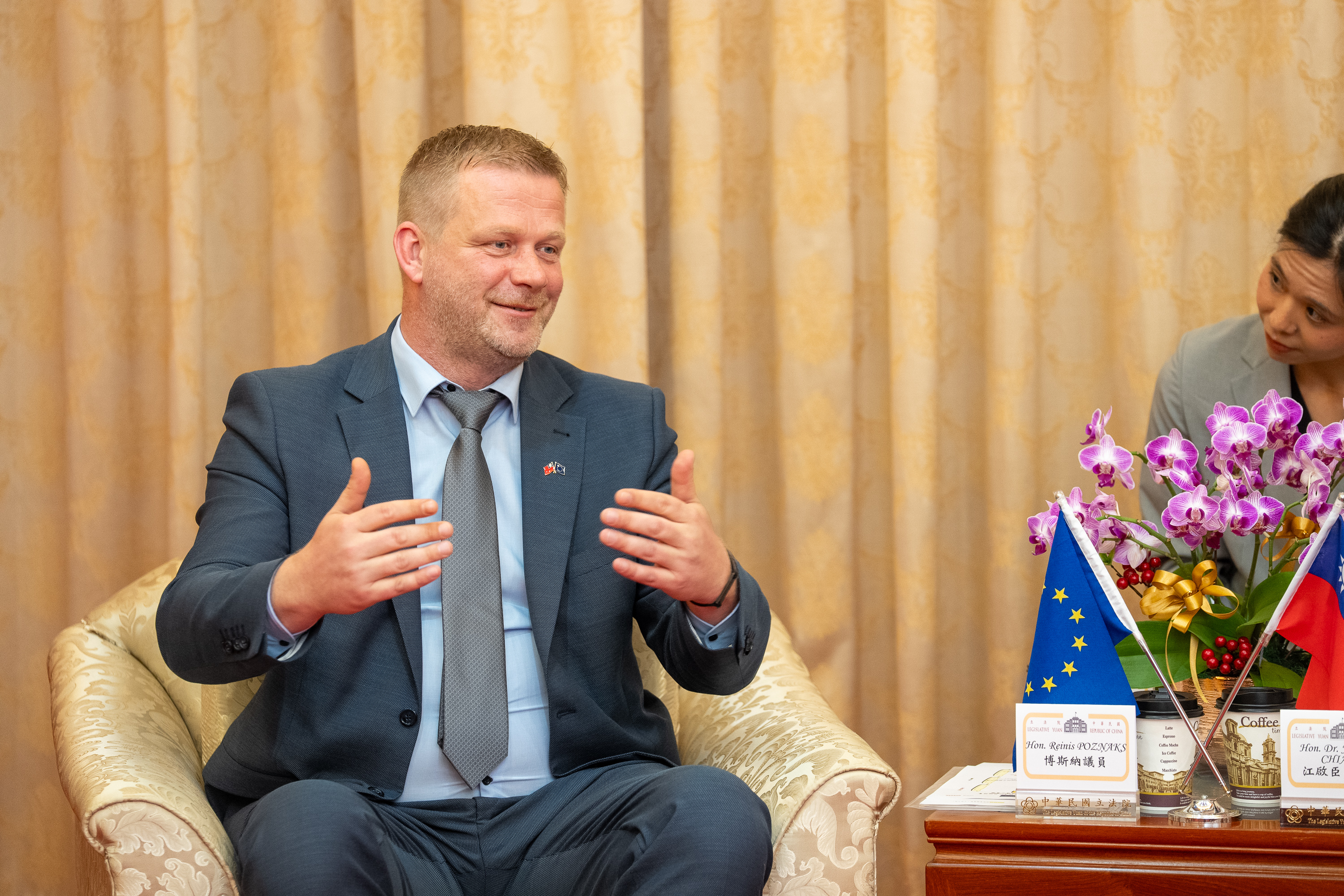
MEP Reinis Pozņaks expressed his great honor in visiting Taiwan and engaging in exchanges with legislators from different political parties. He pointed out that the global political landscape was facing major challenges, and that democratic countries around the world had to join hands to address increasingly severe threats. MEP Pozņaks added that tariff policies are critical issues indeed, but the more pressing matter at present is regional security. He stated that Latvia was particularly sensitive to the war in Ukraine because the country borders Russia and is on the frontline of the conflict. Therefore, he could better understand the Taiwanese people's concerns about regional security. He further stated that he believed Taiwan and Latvia shared many similarities in their respective situations when confronting external threats. He continued by saying that the Russia-Ukraine war had also exposed Europe’s vulnerabilities in key areas such as energy autonomy, calling on European nations to accelerate efforts toward achieving autonomy in energy and defense technology. MEP Pozņaks stressed that the European Union is not a single nation, but a union of 27 member states. Therefore, in the face of global challenges, European countries must not only unite, but all democratic nations should also work together to uphold the international order.
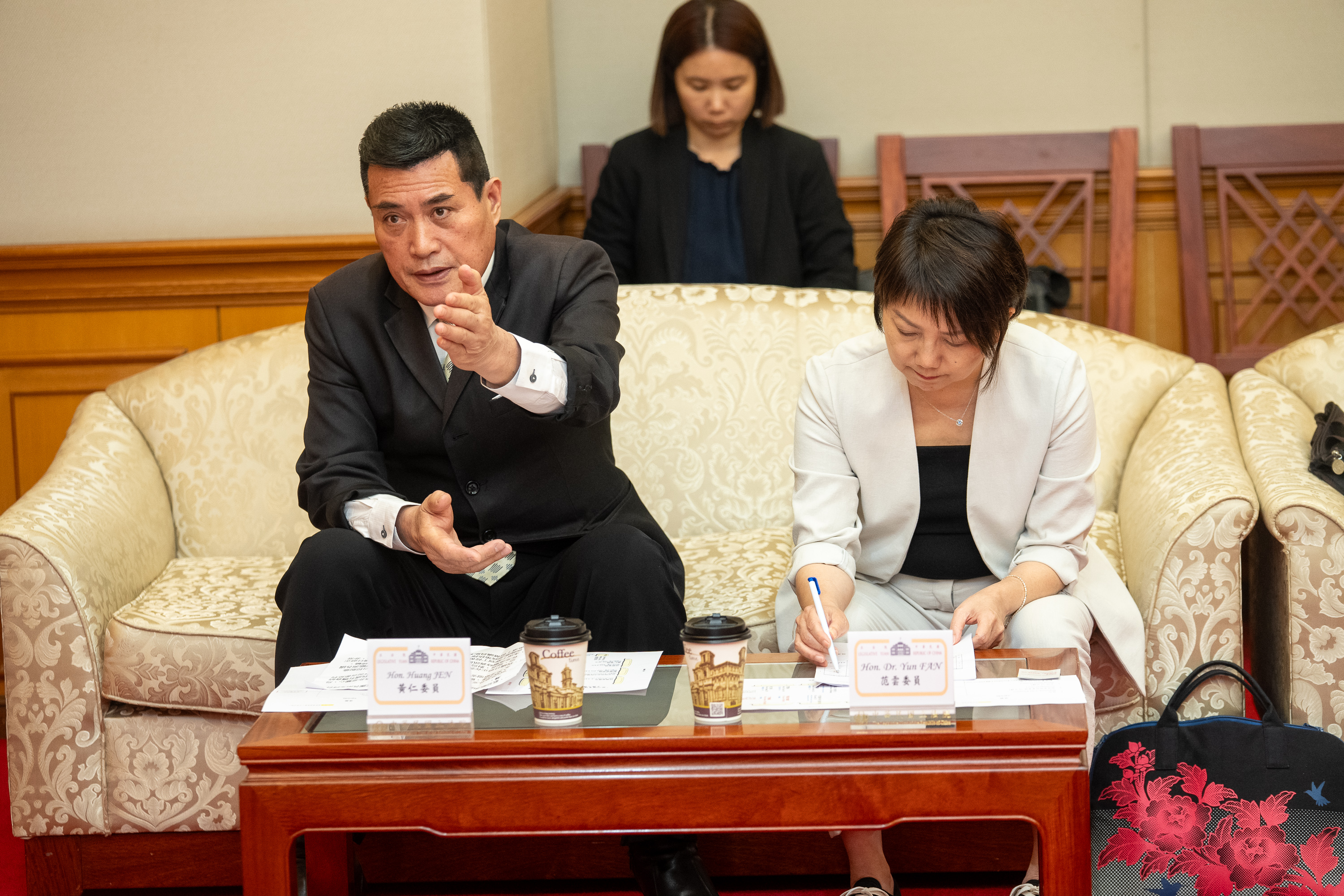
Legislator Huang Jen first expressed his sincere gratitude for the EU's long-standing support for Taiwan. As the convener of the Foreign Affairs and National Defense Committee, Huang said that he has closely followed the evolvement of the Russia-Ukraine war and the development of Europe’s policy in the Indo-Pacific region. He noted that if Taiwan had the opportunity to participate in Europe’s security dialogues or relevant forums regarding defense affairs in the future, it would help strengthen bilateral and strategic trust between Taiwan and Europe, benefiting both sides. He further pointed out that Taiwan is actively enhancing its civil defense system, placing particular emphasis on practical experience in wartime information sharing and the coordination of strategic supplies, and expressed his hope to learn from European countries about relevant systems and practices. Finally, Legislator Huang mentioned that Taiwan is currently at a crossroads as the government determines the direction of Taiwan’s energy policy, so he was particularly eager to understand Sweden’s policies and experiences in the management of nuclear waste, in order to strengthen Taiwan’s future energy security and environmental governance.
Legislator Fan Yun first expressed her heartfelt thanks to the European Parliament for its unwavering backing for Taiwan, especially for its strong stance shown through the passage of multiple pro-Taiwan resolutions. Legislator Fan also expressed her gratitude to MEP Pozņaks for serving as co-chair of the Inter-Parliamentary Alliance on China (IPAC) and for his active support of Taiwan’s international participation and democratic development. She went on to share her experiences from her visit to Finland and Estonia last year, noting that she was deeply impressed by Estonia and Latvia’s planning and implementation of civil defense systems. She also mentioned that the delegation’s itinerary includes visits to the Taiwan FactCheck Center and Kuma Academy, both important civic organizations in Taiwan. She believed that such visits will allow the MEPs to gain deeper insights into Taiwan’s efforts in information defense and national defense education. Legislator Fan emphasized that in today’s global political landscape, Europe has faced security threats from Russia, while Taiwan has long endured oppression and bullying from China. In the face of these shared challenges, as members of the democratic camp, Taiwan and Europe should cooperate even more closely to jointly defend democratic values and the international order.
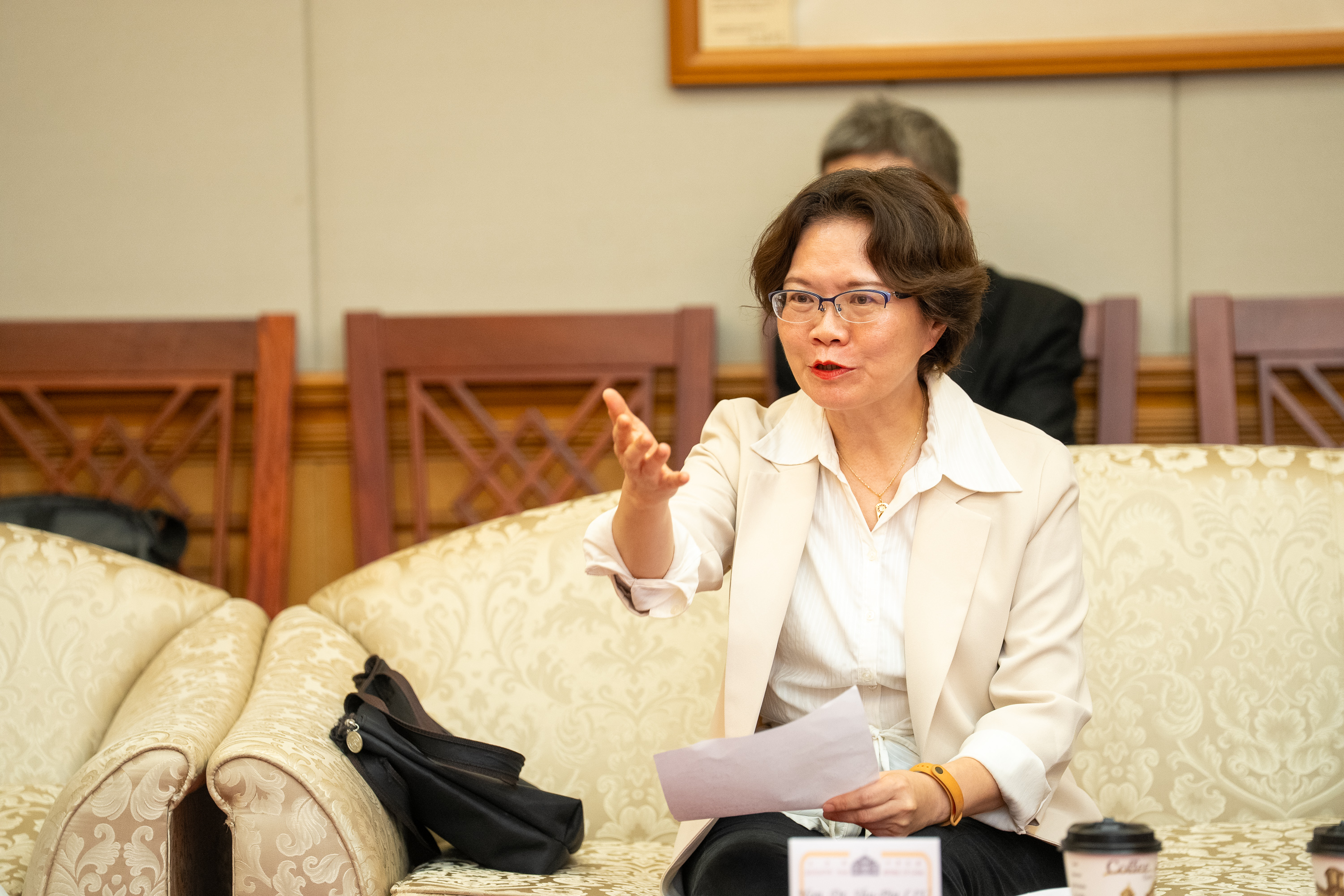
Legislator Liu Shu-Pin remarked that the delegation’s visit will allow Taiwan to witness how the EU has successfully integrated 27 member states, demonstrating unity and the ability to face challenges together. She further asked the three delegates whether, as NATO member states, Latvia, Sweden, and Denmark had increased their national defense budgets following the outbreak of the Russia-Ukraine war, and how the public in each country has responded to these changes. Additionally, she inquired about the impact of Russia-Ukraine war on energy supply and the corresponding measures taken by each country in terms of energy policy. Legislator Liu concluded by asking whether, in light of President Trump’s “America First” policy and the resulting shifts in the international landscape, there would be greater opportunities and room for deepening cooperation between the European Union and Taiwan.
The two sides then engaged in in-depth and meaningful discussions on topics including energy policies, national defense budgets, the Russia-Ukraine war, and Taiwan-EU cooperation. The meeting lasted for about one hour in a warm and cordial atmosphere. The visit concluded successfully with an exchange of commemorative gifts and a group photo.