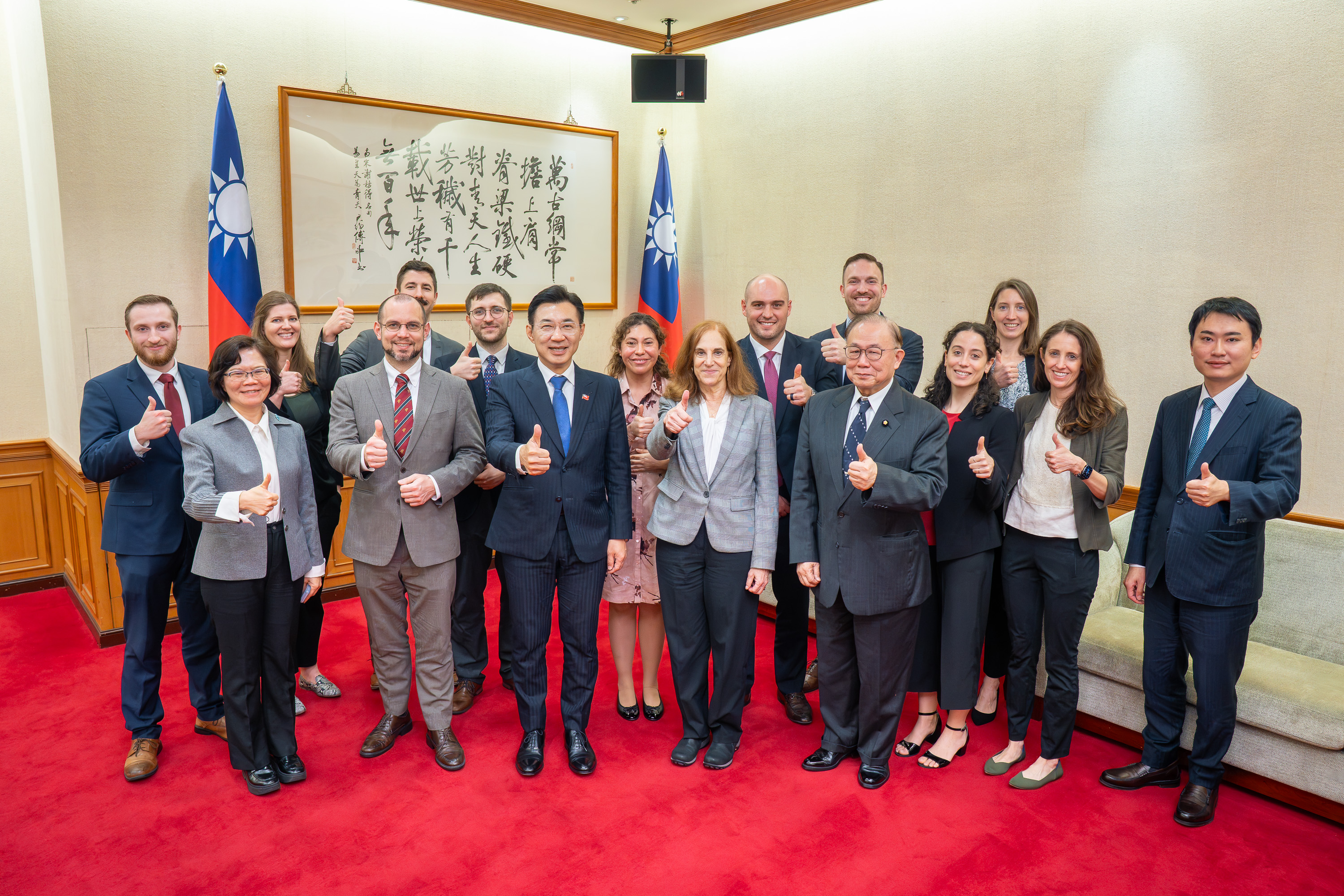
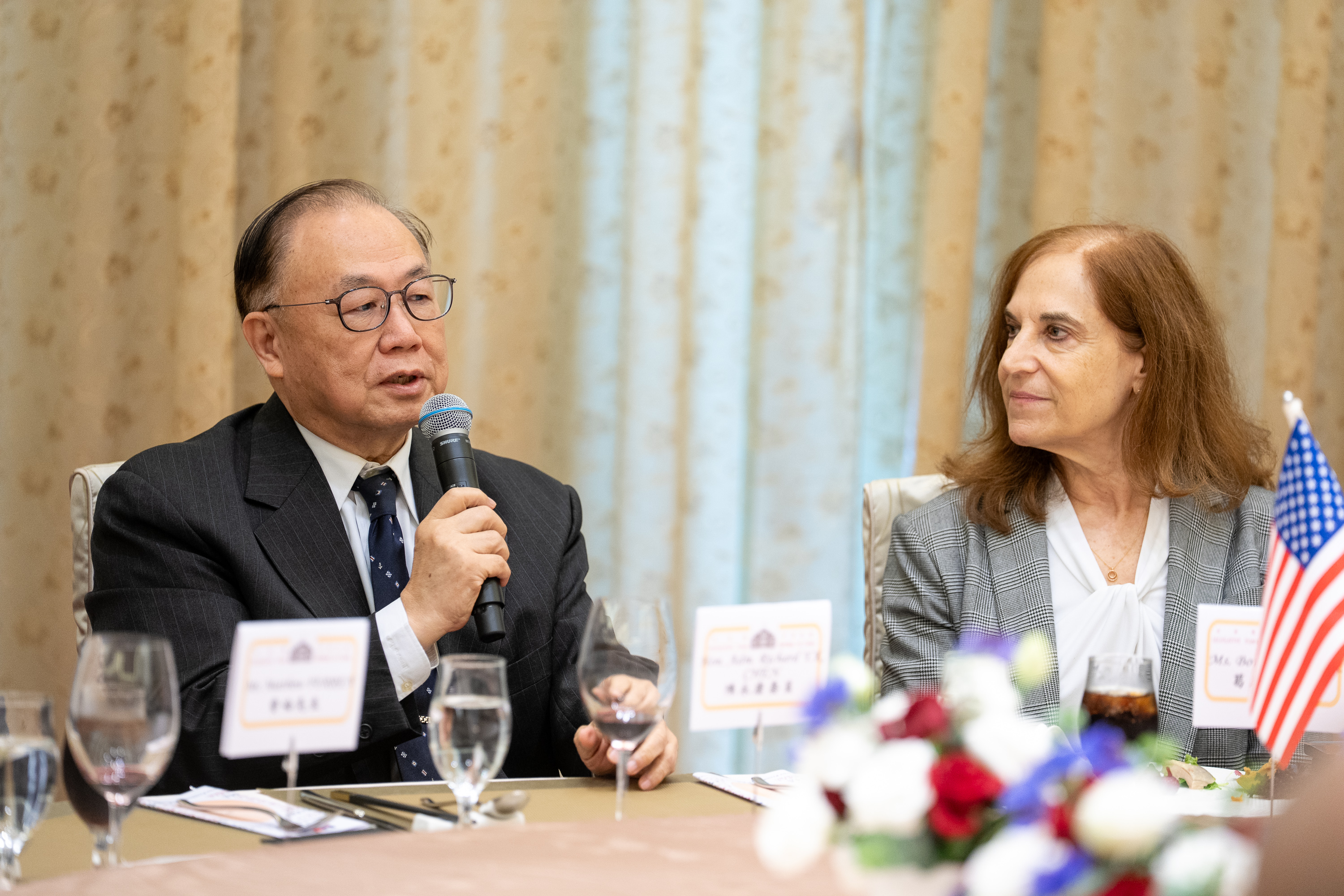
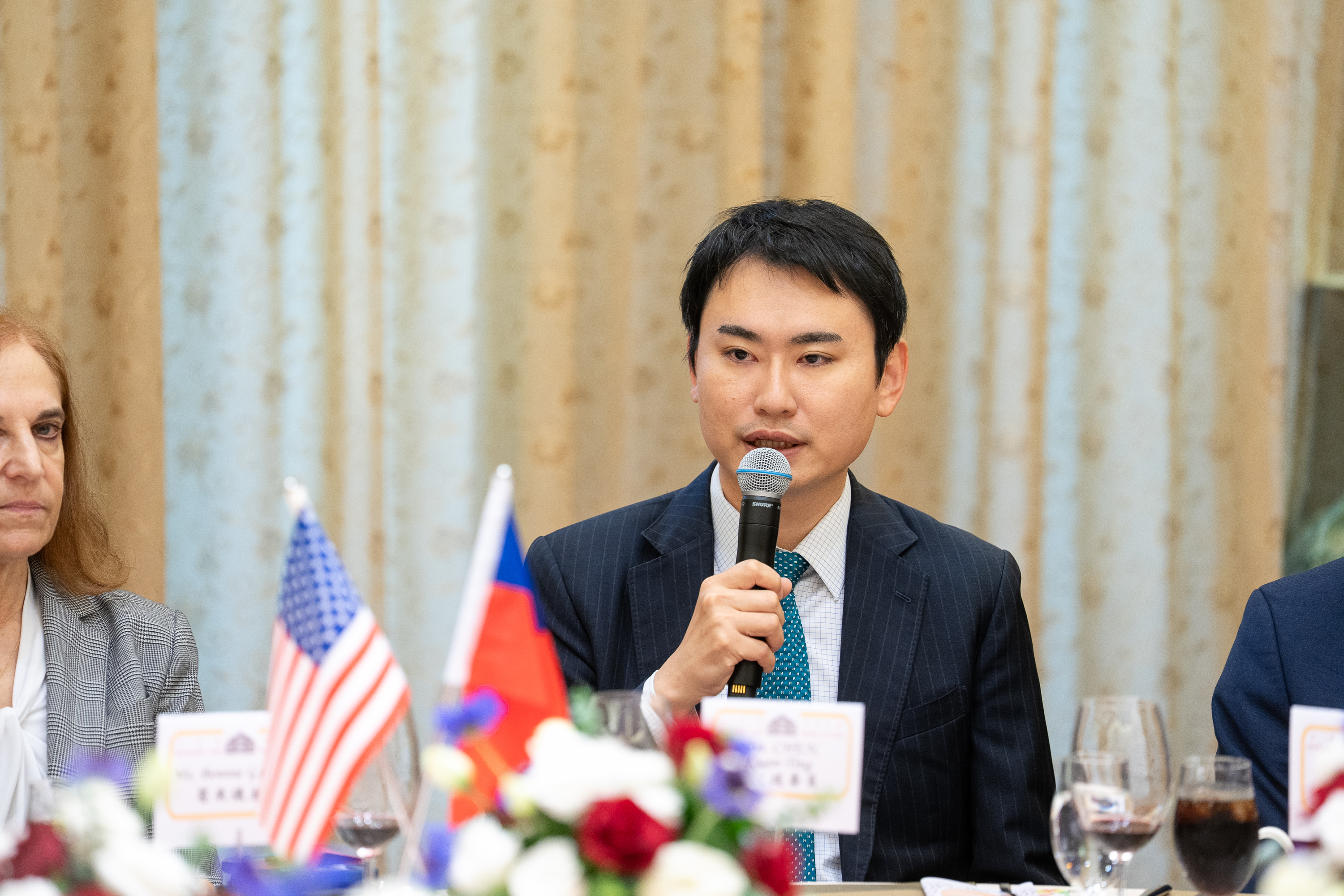
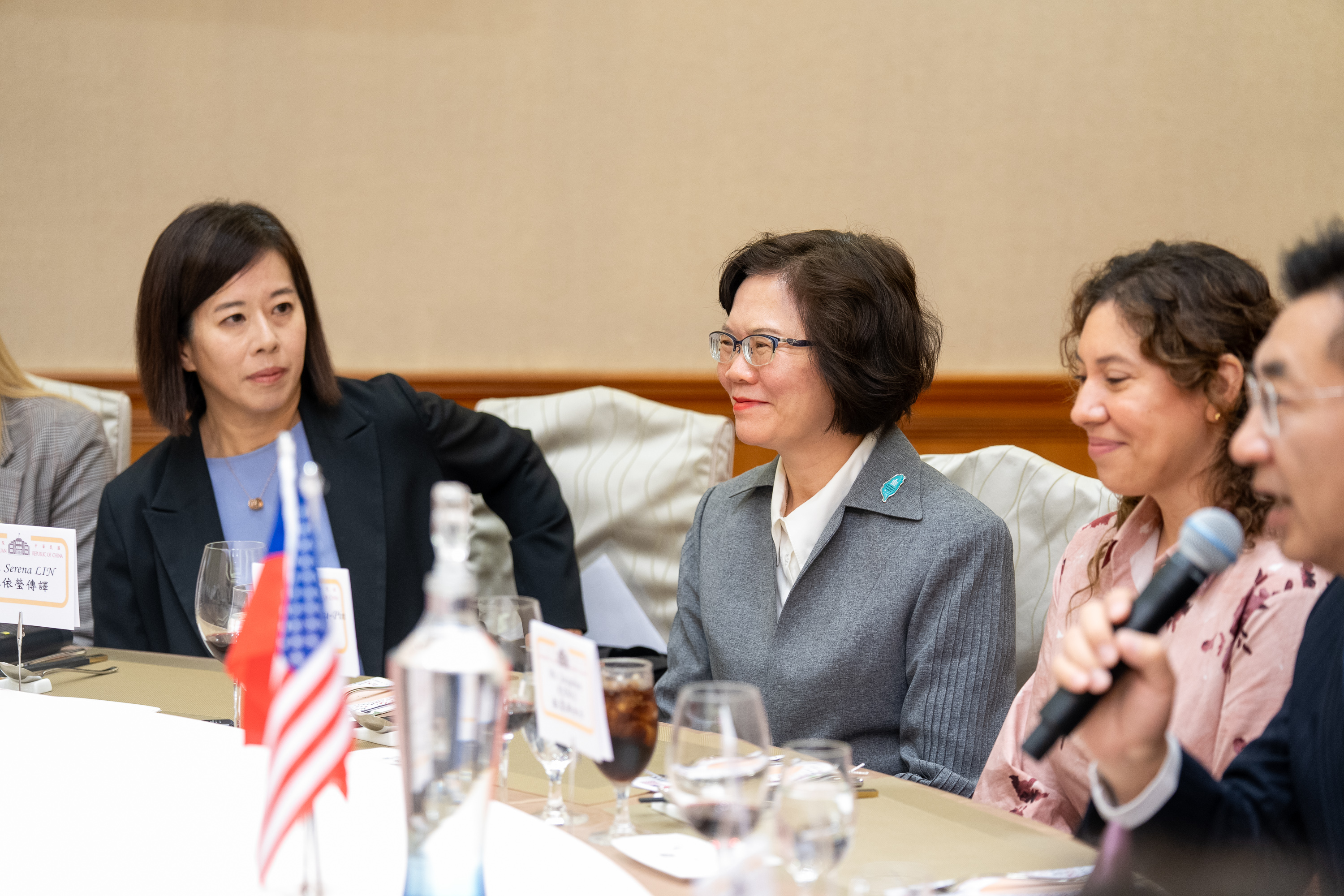
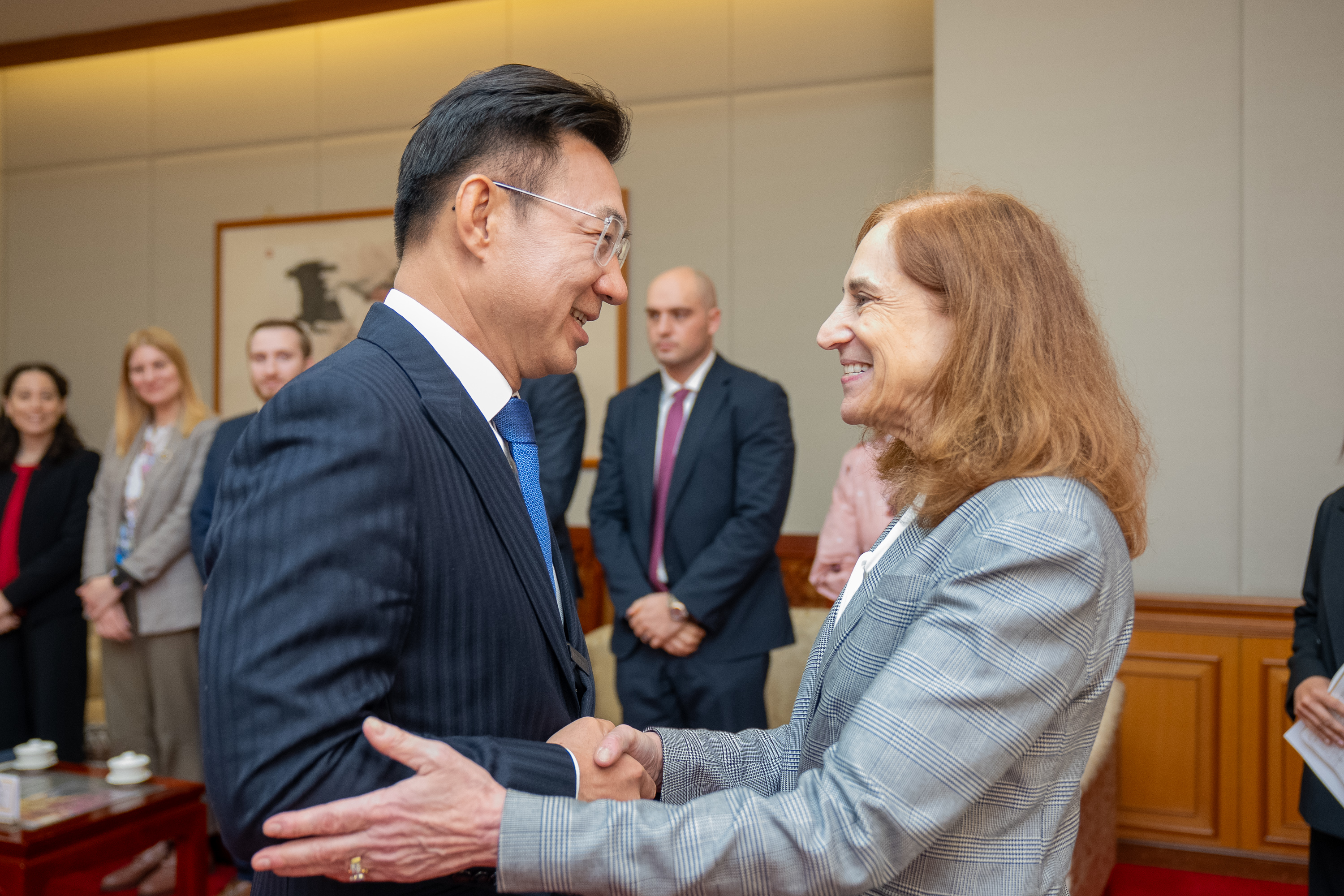
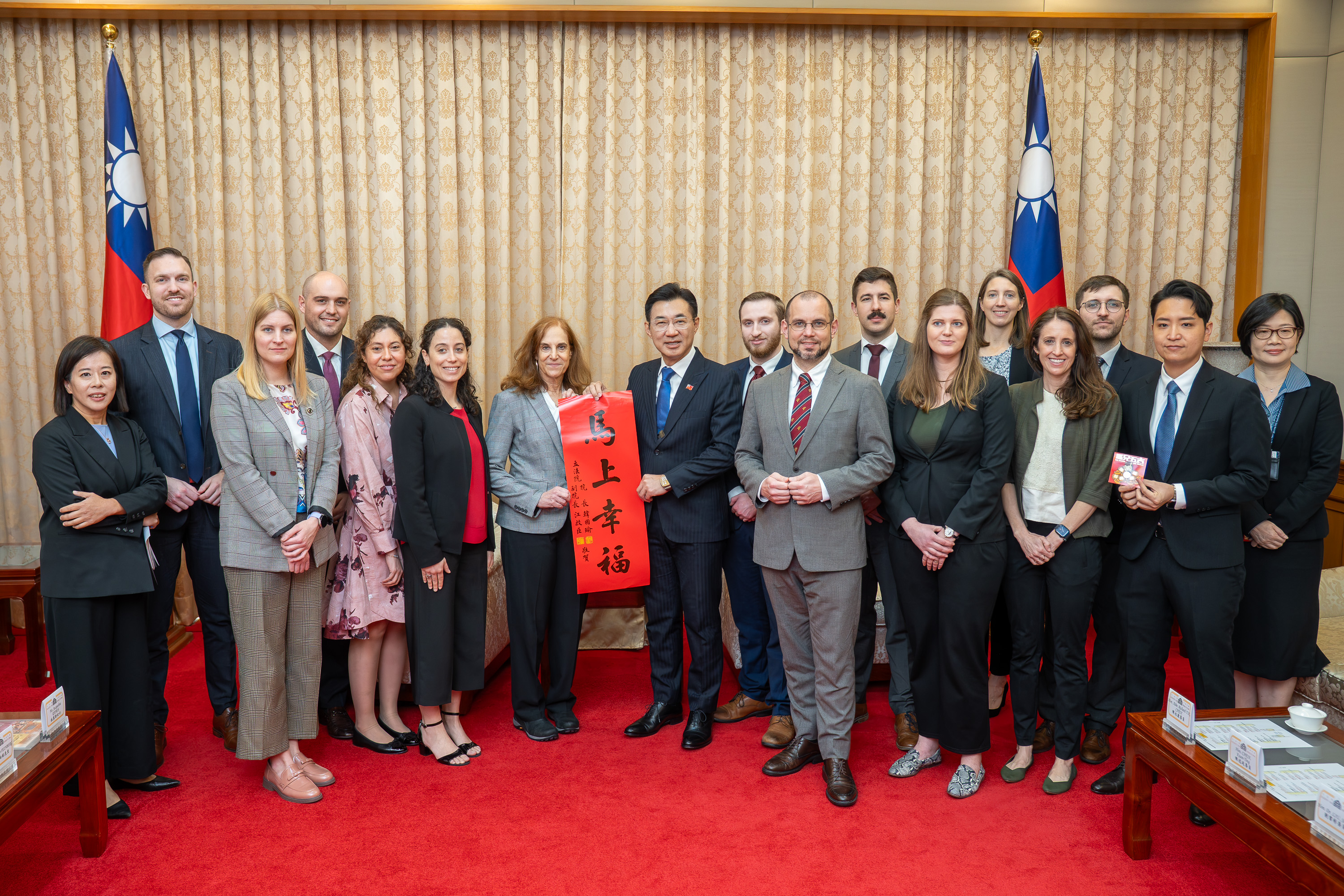
At noon on March 6, Vice President Dr. Johnny C. Chiang (江啟臣) of the Legislative Yuan received and hosted a luncheon for a 14-member delegation from the Taiwan-U.S.-Europe Policy Program (TUPP) of the German Marshall Fund of the United States (GMF). The meeting was joined by KMT Legislators Adm. Chen Yeong-Kang and Lo Ting-Wei, DPP Legislator Chen Kuan-Ting, and TPP Legislator Dr. Liu Shu-Pin. The delegation was led by Ms. Bonnie Glaser, Managing Director of the Indo-Pacific Program at GMF.
Vice President Chiang began by extending a warm welcome to the delegation on behalf of Legislative Yuan President Daniel K.Y. Han (韓國瑜). To celebrate the Lunar New Year, Vice President Chiang presented the guests with festive red envelopes for the Year of the Horse and spring couplets jointly signed by President Han and himself, symbolizing their best wishes for the visitors’ success in the new year. He noted that these gifts were a gesture of Taiwan’s hospitality and encouraged the visitors to take the opportunity to explore other cities across Taiwan. Vice President Chiang also mentioned that he had recently invited former Speaker of the Czech Chamber of Deputies Markéta Pekarová Adamová and Director Raymond Greene of the American Institute in Taiwan (AIT) to visit Taichung. During the visit, they toured industries including precision machinery, robotics, and artificial intelligence and exchanged views with industry representatives on potential future opportunities for bilateral and industrial cooperation.
Vice President Chiang further noted that Taiwan’s manufacturing sector is primarily composed of small and medium-sized enterprises, which are highly sensitive to market changes and developments in the international environment. Since last year, considerable attention has been given to Taiwan-U.S. trade negotiations and to the potential impact of the proposed Agreement on Reciprocal Trade (ART). In fact, given the close and complementary nature of Taiwan-U.S. economic and trade relations, Taiwan has the potential to become the United States’ most trusted economic and trade partner, creating mutually beneficial outcomes for both sides.
Vice President Chiang also pointed out that many members of the visiting delegation specialize in security and defense issues and noted that Taiwan currently faces a complex and critical security environment. He added that, in response to the widespread attention surrounding Taiwan’s special defense budget, he and President Han had issued a joint statement during the Lunar New Year holiday committing to prioritize the examination of the special defense budget during the current legislative session. He explained that no single party currently holds a majority in the Legislative Yuan, and therefore policy decisions require consultation and consensus-building among parties. Although the decision-making process may take time, this is an inherent part of the democratic process, and he expressed confidence that consensus will ultimately be reached regarding the resources needed for national security.
Vice President Chiang concluded by thanking Ms. Glaser for leading delegations of experts and friends to Taiwan over the years. He noted that face-to-face discussions help deepen mutual understanding of policy issues, narrow differences in perspectives, and promote more concrete cooperation. He also wished the guests happiness and success in the Year of the Horse.
Ms. Glaser, Managing Director of the GMF’s Indo-Pacific Program, thanked Vice President Chiang and the four legislators for taking time to receive the delegation. She noted that Taiwan’s special defense budget has recently drawn significant attention and emphasized that security is of vital importance to the people of Taiwan. Over the past eight years, the United States has continued to support Taiwan’s defense procurement needs to help strengthen Taiwan’s defense capabilities, an effort she described as important to the broader security architecture.
Legislator Adm. Chen Yeong-Kang stated that the KMT caucus, like the governing party, supports increasing the defense budget, although differences remain regarding specific details. Resolving such differences through consultation, he said, reflects the essence of democratic politics. Legislator Adm. Chen also noted that President Han and Vice President Chiang have been working diligently to promote cross-party consultations and expressed confidence in the parliamentary procedures during the current session. While expressing appreciation for the United States’ strong support for Taiwan’s democracy, he also emphasized the importance of strengthening personnel training and enhancing societal resilience, and suggested that Taiwan should develop its own national defense strategy.
DPP Legislator Chen Kuan-Ting, who represents Chiayi County, noted that the county has been actively developing drone and aerospace industries. He added that Taiwan’s planned special defense budget includes strengthening military procurement and cooperation with the United States in unmanned systems. He emphasized that Taiwan’s small and medium-sized enterprises possess strong manufacturing capabilities and expressed hope that with better alignment of capital and technology, Taiwan and the United States could jointly engage in the production and maintenance of unmanned systems and related platforms. Regarding recent escalations in gray zone activities involving China’s drones in the waters south and southwest of Taiwan, he added that establishing precise and appropriate response principles while avoiding escalations of conflict remains a key issue requiring careful consideration.
Legislator Dr. Liu Shu-Pin explained the TPP’s position on arms procurement and the defense budget. She noted that the budget proposal put forward by the party falls between the proposals of the KMT and the Executive Yuan. She argued that procurement items and funding amounts should be clearly specified, and that the budget should be allocated on an annual basis rather than as a single eight-year package. Under this approach, the Executive Yuan would submit plans to the Legislative Yuan each year for examination, allowing for more effective legislative oversight. She also pointed out that Taiwan’s overall government budget is about NT$3 trillion. Increasing the defense budget to NT$900 billion, she said, could crowd out spending in other policy areas and therefore requires careful evaluation.
During the discussions, both sides exchanged views on a range of issues, including gray zone security threats that Taiwan is facing, the development of the unmanned systems industry and international cooperation, Taiwan-U.S. military training and logistics integration, energy security and nuclear energy policy, opportunities for industrial cooperation between Europe and Taiwan, and cooperation between Taiwan and the United States in areas such as artificial intelligence, robotics, and manufacturing. The meeting and luncheon lasted approximately two hours and concluded in a lively and cordial atmosphere following an exchange of gifts and a group photo. (2026/03/06)