
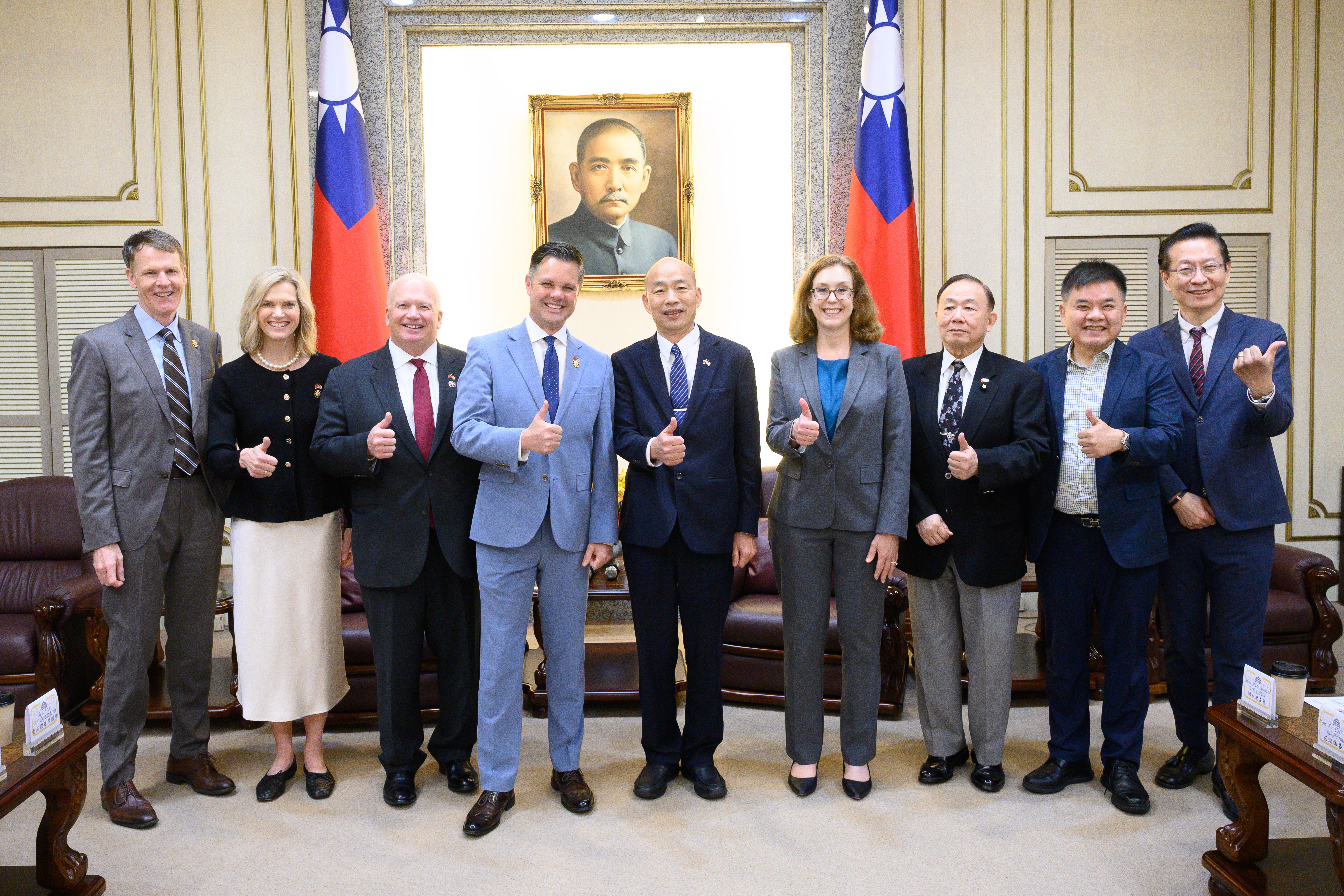



On the afternoon of April 8, President Daniel K.Y. Han (韓國瑜) of the Legislative Yuan received a seven-member delegation led by Representative Zach Nunn, Chairman of the National Security Task Force of the U.S. House Republican Study Committee (RSC). President Han was accompanied by KMT Legislator Adm. Chen Yeong-Kang, DPP Legislator Dr. Chuang Jui-Hsiung, and TPP Legislator Dr. Wang An-Hsiang.
President Han first extended a warm welcome to the delegation and noted that amid a turbulent international landscape, the visit by an important U.S. congressional delegation to Taiwan is especially meaningful. Looking back on history, President Han stated that since U.S. President Harry S. Truman dispatched the Seventh Fleet to patrol the Taiwan Strait in 1950, the United States has long helped maintain regional security and stability, for which the people of Taiwan remain deeply grateful.
President Han then introduced the cross-party legislators in attendance. Drawing a vivid comparison, he noted that lawmakers must balance legislative duties, constituency services, and family life at the same time, shouldering multiple responsibilities while facing similar challenges and pressures. President Han also took the opportunity to brief the delegation on Taiwan’s diverse strengths. He emphasized that although Taiwan is small in land area and densely populated, it holds a key position in global supply chains. In addition to its global leadership in semiconductors and artificial intelligence, Taiwan is also internationally recognized for its traditional manufacturing, medical technology, and culinary culture, fully demonstrating its economic resilience and soft power.
Representative Nunn, head of the delegation, thanked President Han and the legislators present for their warm hospitality. He noted that the U.S. Congress and Taiwan’s Legislative Yuan share certain similarities in structure and operation, enabling both sides to understand the challenges and pressures faced under a democratic system. He emphasized that the U.S. Congress has long supported Taiwan-U.S. relations on a bipartisan basis. As this year marks the 47th anniversary of the Taiwan Relations Act, he said the bilateral partnership remains strong and continues to deepen.
Representative Nunn further stated that the RSC is one of the largest caucuses in the U.S. House of Representatives and holds significant influence in policy advocacy. The RSC has long upheld the principle of “Peace through Strength,” emphasizing effective deterrence through strengthened defense capabilities. He noted that the United States is actively moving forward with the National Defense Authorization Act (NDAA), and urging allies to increase defense budgets and deepen security cooperation. He also stated that he will work to ensure that Taiwan can obtain the defense matériel and resources it needs in a timely manner, while also seeking to deepen cooperation in areas such as energy security, advanced nuclear energy, and clean energy, so as to strengthen Taiwan’s overall resilience.

During the exchange, Legislator Chen stated that as Taiwan strengthens its defense budget, it should also pay attention to long-term sustainment measures, including logistical maintenance, professional training, and systems integration. He also emphasized that Taiwan could draw on the U.S. practice of formulating a National Security Strategy document in order to build a more forward-looking and enduring cross-party strategic consensus.
Legislator Chuang emphasized that although domestic party competition in Taiwan is intense, the ruling and opposition parties share a high degree of consensus on defending democratic values and national security. He expressed hope that all parties will work together to advance the defense budget and related policies.
Legislator Wang also welcomed the delegation and reiterated that the TPP firmly supports national security and the defense budget. He expressed hope that Taiwan and the United States can develop more areas of cooperation in order to jointly promote national security, and maintain peace and stability across the Taiwan Strait.
The two sides then exchanged views on global developments, Taiwan-U.S. economic and trade relations, regional security, energy resilience, and the operation of legislative proceedings. The meeting lasted approximately one hour in a cordial and warm atmosphere. It concluded successfully with an exchange of commemorative gifts and a group photo. (2026/04/08)