


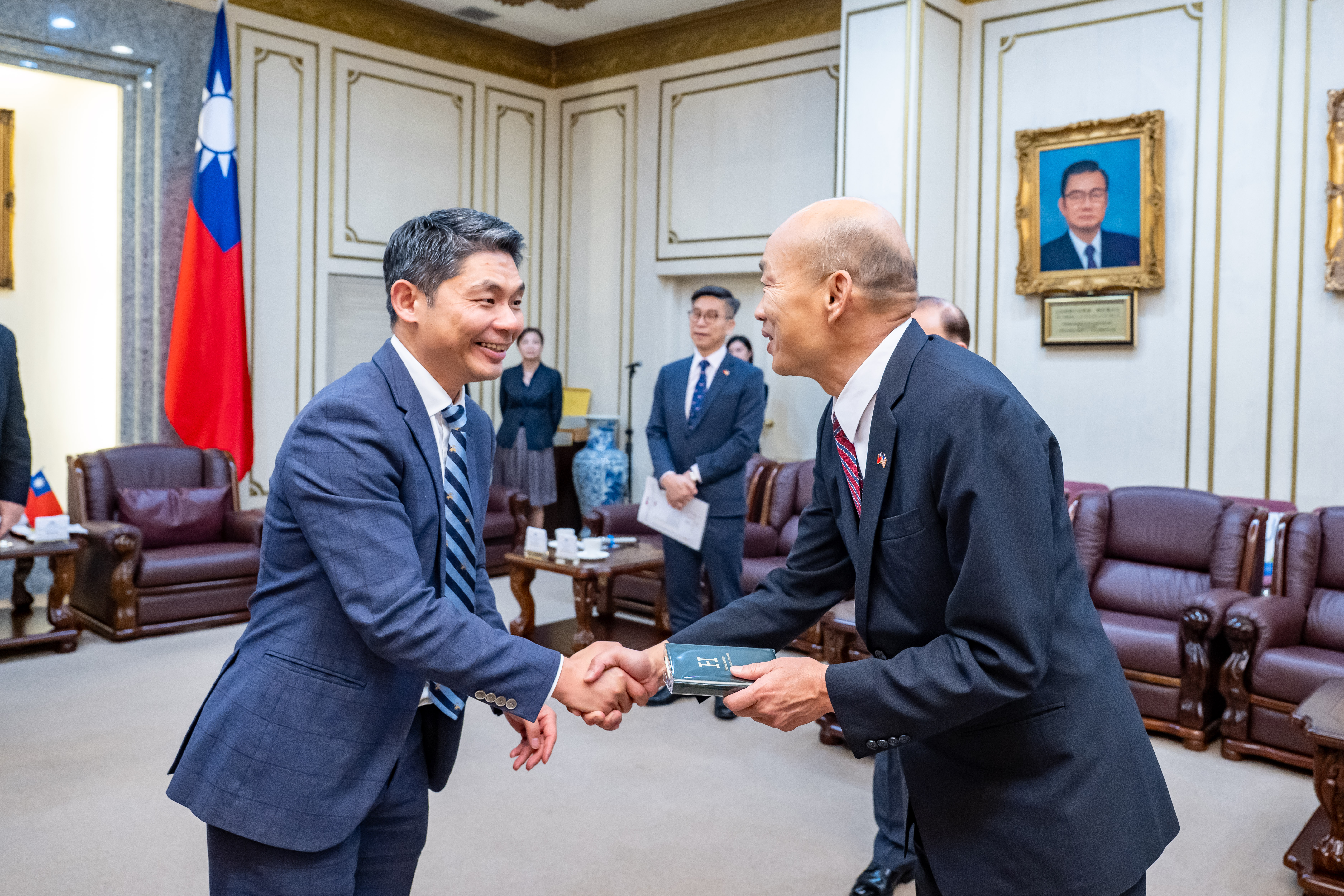
On the afternoon of April 15, Legislative Yuan President Daniel K.Y. Han (韓國瑜), accompanied by KMT Legislator Adm. Chen Yeong-Kang, DPP Legislator Chung Chia-Pin, and TPP Legislator Dr. Wang An-Hsiang, received a delegation of scholars from U.S. think tanks.
President Han opened the meeting by extending a warm welcome to the delegation and introducing each attending legislator from across party lines. He then stated that, just as law enforcement is concerned with public safety, the education sector with education, and the financial and economic sectors with the economy, security has become a core issue of concern across all sectors amid changes in the global landscape in 2026. Security is also an issue to which all parties at the Legislative Yuan attach great importance. President Han also stated that Taiwan and the rest of the world aspire to security. Taiwanese people, he said, have a particularly strong awareness of security and hope for cross-strait stability, world peace, and the ability to live and work in peace and contentment.
The head of the delegation, Hsu Yu-Jen, a senior fellow at the Hudson Institute, thanked President Han and legislators from across party lines for taking the time to meet with the delegation. He said that although his role had changed, his love for the Republic of China had never changed. Senior Fellow Hsu further pointed out that as the global situation changes rapidly, Taiwan is playing an increasingly important role in the global semiconductor supply chain and in strategic terms. The delegation, he said, understood and respected Taiwan’s legislative procedure. As the special defense budget bill was undergoing party caucus negotiation, this visit to Taiwan was particularly intended to convey U.S. concern for Taiwan’s security and to express that the U.S. will continue to promote cooperation with Taiwan.
The co-head of the delegation, Mark Montgomery, a senior director at FDD, affirmed Taiwan’s democratic development and shared Ukraine’s experience in planning its national defense budget. He expressed hope that legislators from across party lines at the Legislative Yuan could reach a consensus on the deliberation of the national defense budget and demonstrate Taiwan’s determination to defend itself to the international community.

Legislator Chen welcomed the delegation to the Legislative Yuan. He said that the visit fully demonstrated the importance U.S. think tanks attach to Taiwan’s national defense and security. He emphasized his support for increasing the national defense budget and recommended strengthening personnel training, command systems, and communications resilience. He also said he would be pleased to further exchange views on arms procurement and other issues.

Legislator Chung expressed deep concern about issues related to geopolitics, such as ASEAN, new energy, space, and unmanned vehicles. He said that the U.S. has strengths in technological research and development, while Taiwan has advanced manufacturing capabilities. He believed that bilateral cooperation would certainly help establish a stable non-red supply chain and expressed hope for in-depth exchanges with the delegation on this issue.
Legislator Wang stated that TPP is a relatively young party, compared with Taiwan’s two major political parties. TPP supports increasing the national defense budget on the premise of appropriate parliamentary oversight and fiscal discipline. He also thanked the U.S. for its long-standing support for Taiwan.
Subsequently, the two sides held extensive and in-depth exchanges on the U.S.-China presidential summit, national defense issues, and Taiwan’s immigration policy. The meeting lasted approximately 50 minutes and concluded in a warm and cordial atmosphere. (2026/04/15)