

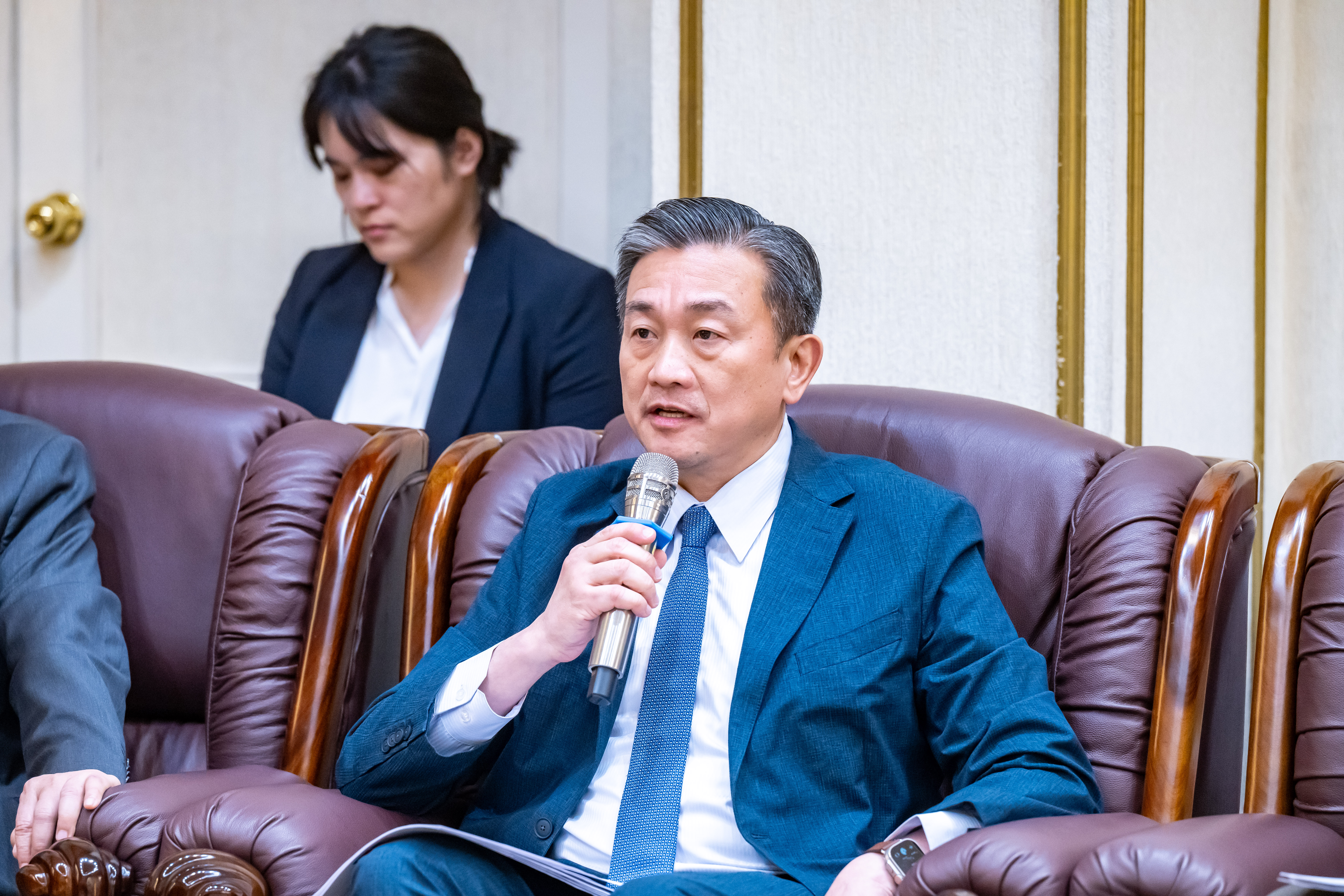
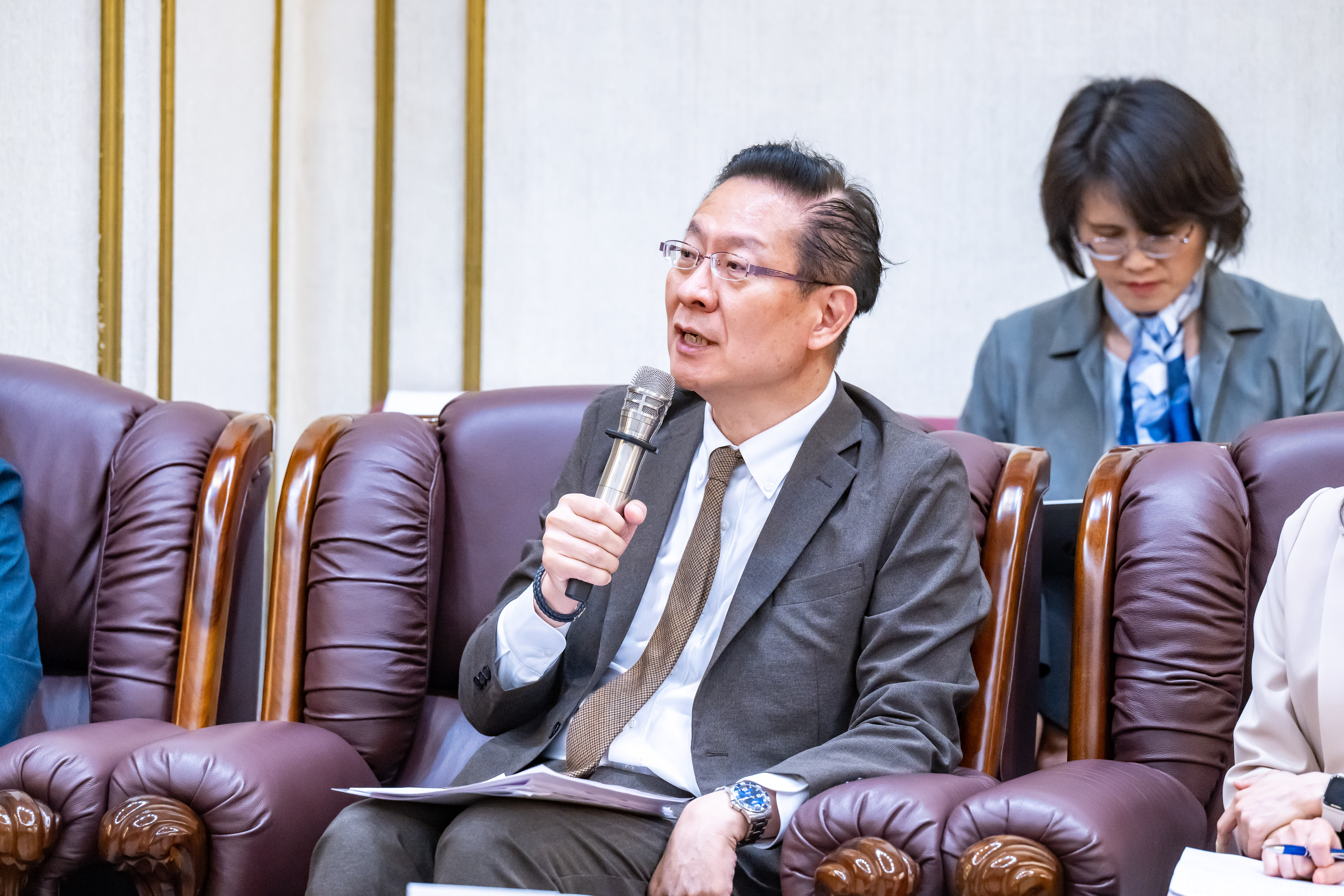
On the afternoon of April 22, Legislative Yuan President Daniel K.Y. Han (韓國瑜) received a five-member delegation from the Center for Strategic and International Studies (CSIS), a Washington-based think tank. Also in attendance were KMT Legislator Adm. Chen Yeong-Kang, DPP Legislator Dr. Wang Ting-Yu, and TPP Legislator Dr. Wang An-Hsiang.
President Han began the meeting by extending a cordial welcome to the delegation. He noted that the Legislative Yuan has hosted numerous foreign guests in recent years, proving that Taiwan has become an international focal point of attention. He also mentioned that most visitors left with a positive and deep impression of Taiwan’s vibrant democracy and the hospitality of its people.
President Han added that the Legislative Yuan adopts a unicameral system and comprises 113 legislators. He stated that while different political parties hold different positions and engage in heated debates during parliamentary proceedings, they consistently display unity and warmth when welcoming international friends. He remarked that the attendance of legislators representing different political parties demonstrates the diversity and inclusivity of Taiwan as a democracy.
President Han also stressed that national security is an issue to which legislators across party lines attach great importance. He affirmed that he will help the party caucuses to forge a consensus, ensuring that the Legislative Yuan can fulfill its duty by responding to the public’s concerns over the proper appropriation of relevant budgets and deliberating on the special defense budget act.

One of the delegates, Dr. Victor Cha, thanked President Han and the legislators for taking the time to meet with the delegation. He highlighted that the trip provided a deeper understanding of the vital role and influence of the Legislative Yuan within Taiwan’s constitutional system and commended the diversity and inclusivity of Taiwan’s democracy. He also expressed hope to gain further insight into the status of Taiwan’s defense budget review, as well as the positions and views of major parties.

During bilateral discussions, Legislator Chen pointed out that legislators unanimously support the defense budget despite their differing political positions. He emphasized that unmanned vehicles and autonomous systems are the trends of future warfare; therefore, it is imperative for Taiwan to enhance the training of specialized personnel in tandem with equipment procurement. He also underlined the importance of command systems, communications resilience, and the integration of overall combat capabilities. In addition, he reiterated that education and institutional frameworks for artificial intelligence (AI) should be advanced concurrently.
Legislator Wang Ting-Yu thanked the delegation for showing concern regarding Taiwan’s defense security. He noted that Taiwan must take responsibility for its own security, and that legislators across party lines need to support the defense budget in the face of growing threats from China. He explained the review status of the 2026 general budget and the special defense budget act to the delegation, stressing that legislators, despite their differing positions, will fulfill their responsibility and complete the relevant legislative procedures for the budgets. He also expressed hope that the delegation will continue to use their influence and support Taiwan’s defense security after returning to the U.S.
Legislator Wang An-Hsiang outlined the consistent position of the Taiwan People’s Party over the defense budget and emphasized his support for any necessary measures to help maintain national security. He went on to remark that under President Han’s leadership, the second cross-party caucus negotiation is expected to progress smoothly so as to reach a consensus and facilitate the subsequent examination process. He also added that Taiwan must continue to deepen exchanges with the U.S. in areas such as military cooperation and industrial supply chains.
Both sides proceeded to exchange views on issues of mutual interest, including economics, finance, social resilience, and the overall development of Taiwan. The discussions were candid and friendly. The meeting lasted approximately 60 minutes and concluded successfully with the exchange of commemorative gifts and a group photograph. (2026/04/22)