

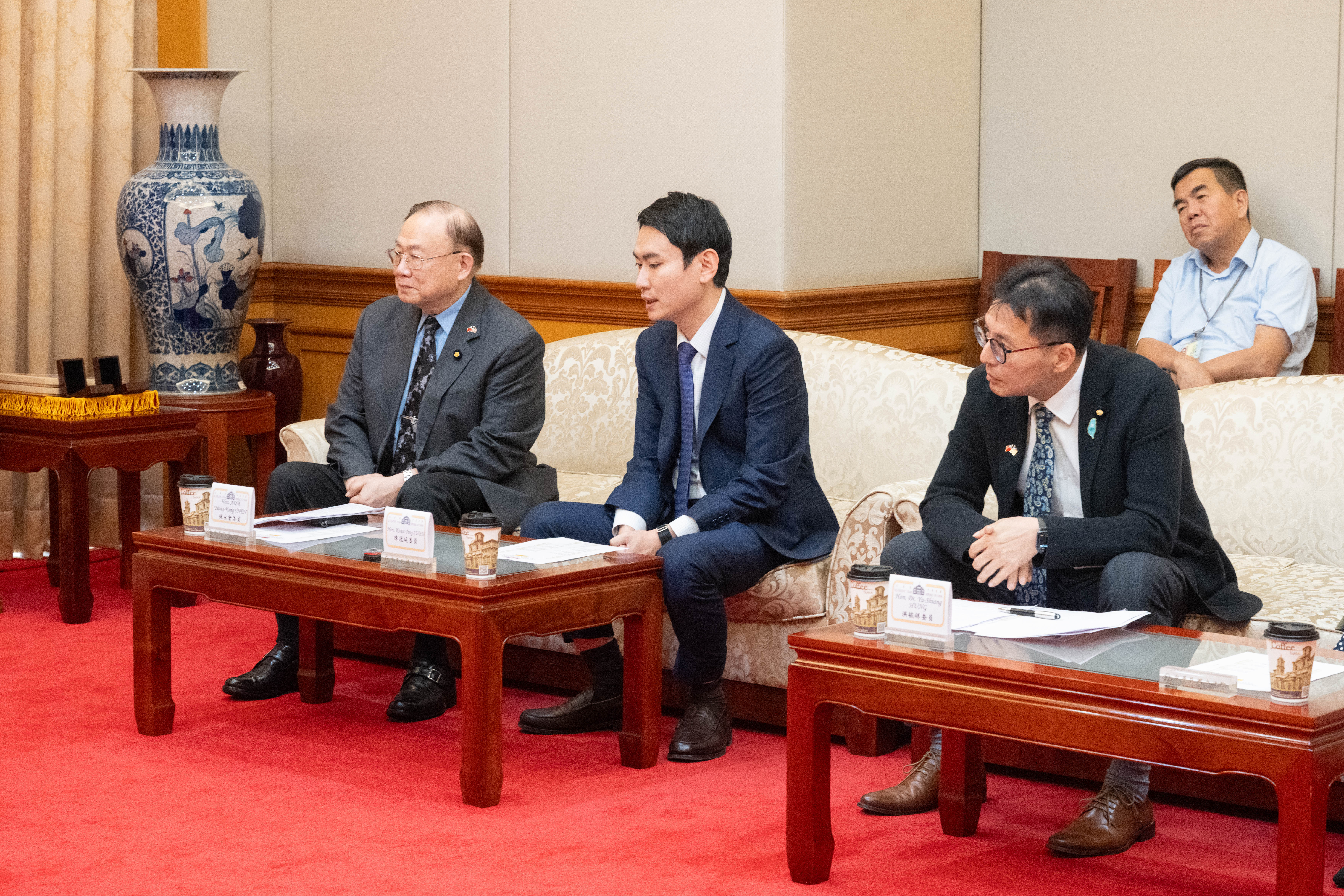
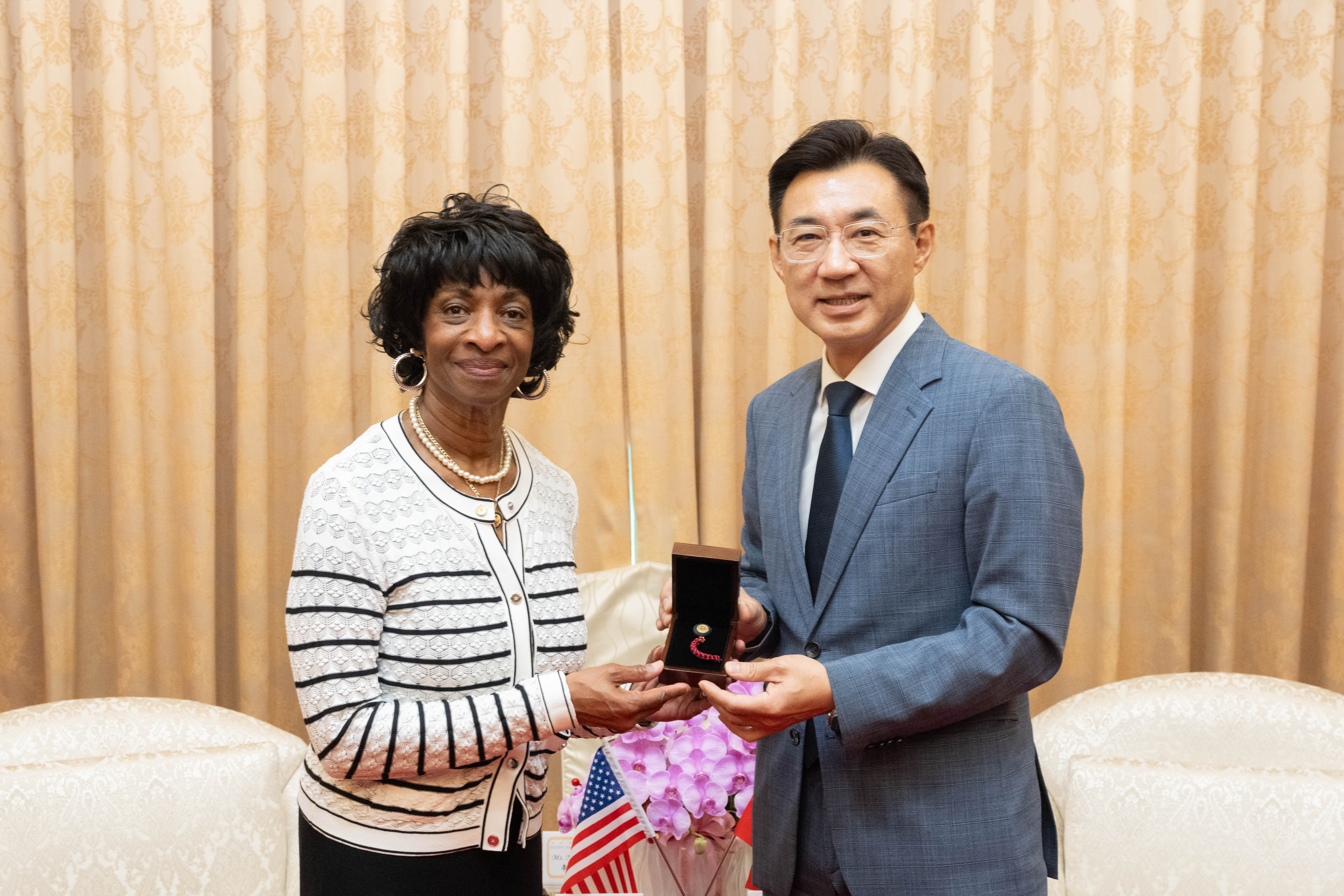
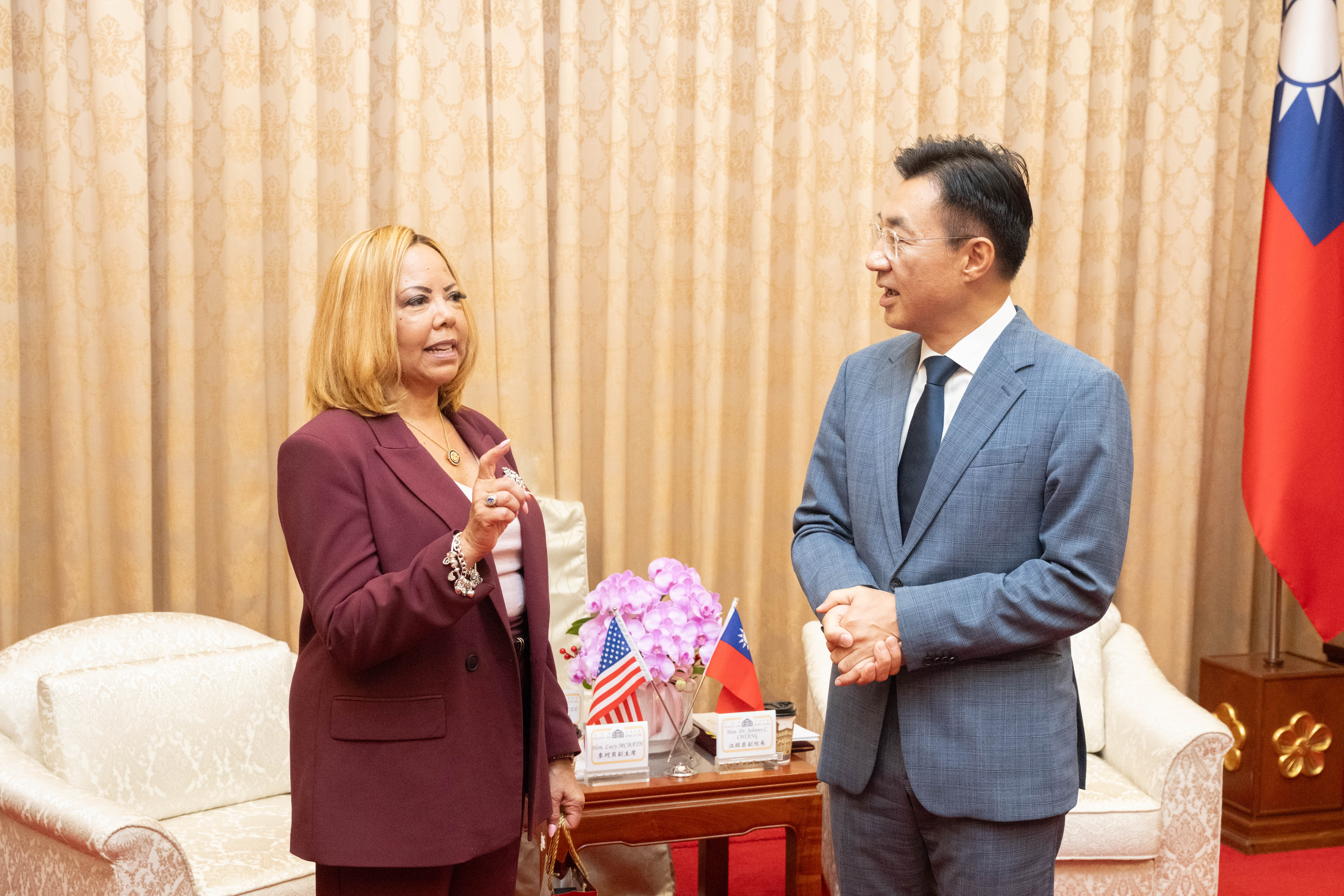
On the morning of June 16, Legislative Yuan Vice President Dr. Johnny C. Chiang (江啟臣), accompanied by KMT Legislator Adm. Chen Yeong-Kang, DPP Legislator Chen Kuan-Ting, and TPP Legislator Dr. Hung Yu-Hsiang, received a four-member delegation led by U.S. Representative Lucy McBath, Second Vice Chair of the Congressional Black Caucus (CBC) of the U.S. House of Representatives.
Vice President Chiang began by extending a warm welcome to the delegation on behalf of the Legislative Yuan and Legislative Yuan President Daniel K.Y. Han (韓國瑜). He recalled leading a cross-party delegation of legislators to Washington, D.C., in April 2025, during which they were warmly received by members of the U.S. Congress. Noting that this was the first delegation from the CBC to visit the Legislative Yuan, Vice President Chiang said the occasion underscored the strong ties between the legislatures of Taiwan and the United States. He also expressed the Legislative Yuan’s appreciation for the United States’ longstanding support for Taiwan.
Vice President Chiang also mentioned that, at the invitation of the Georgia Institute of Technology, he had traveled to Atlanta in May to exchange views on AI technology and the robotics industry and to discuss opportunities for industrial cooperation with the state government. As Second Vice Chair McBath represents Georgia, he expressed hope that the two sides would continue to deepen their exchanges in the future.
Vice President Chiang further noted that this year marks the 250th anniversary of the founding of the United States and that Taiwan-U.S. relations have grown increasingly close through people-to-people exchanges and congressional engagement. In terms of trade and economic ties, bilateral trade exceeded US$246 billion in 2025, making Taiwan the United States’ fourth-largest trading partner and the United States Taiwan’s largest trading partner. In addition, nonstop flights between Taipei and Washington, D.C. are scheduled to commence on June 26. The new route will make travel between the two sides more convenient and further facilitate people-to-people exchanges. To further deepen Taiwan-U.S. relations, President Han will also lead a cross-party delegation of legislators to the United States to attend events celebrating the country’s 250th anniversary and meet with members of Congress and other government officials and political leaders. Vice President Chiang expressed hope that President Han’s delegation would have another opportunity to meet with Second Vice Chair McBath and the other members of the visiting delegation.
Vice President Chiang went on to say that, in addition to congressional exchanges, Taiwan hopes to deepen cooperation with the United States at both the central and local government levels. Amid rapid advances in AI and digital transformation, as well as shifting geopolitical dynamics, democratic partners must work more closely together. He expressed confidence that broader and more comprehensive exchanges would help further strengthen Taiwan-U.S. relations.
Vice President Chiang emphasized that the Legislative Yuan has always attached great importance to exchanges with the U.S. Congress. The Legislative Yuan USA Caucus, established in 2024, currently has 71 members, making it one of the largest parliamentary friendship groups in the Legislative Yuan. Vice President Chiang also serves as its honorary president. He stated that the group would continue to serve as a platform for promoting reciprocal visits and cooperation between the two sides, allowing Taiwan and the United States to make greater contributions to the advancement of democratic values and the international community. Vice President Chiang concluded by once again welcoming the delegation and wishing its members a smooth, successful, and rewarding visit. He expressed hope that the delegation members would experience firsthand the warmth of the Taiwanese people, the vitality of Taiwan’s industries, and the progress of Taiwan’s democratic development, thereby further deepening the friendship between the legislatures of Taiwan and the United States.
In her remarks, Second Vice Chair McBath, head of the delegation, thanked Vice President Chiang and the legislators for their warm reception and conveyed her sincere appreciation on behalf of the CBC of the U.S. House of Representatives. She stated that Taiwan-U.S. relations are founded on mutual trust, innovation, and cooperation and have developed steadily over several decades. On behalf of the U.S. Congress, she also reaffirmed its support for Taiwan.
Second Vice Chair McBath further noted that, as a member of the House Committee on Education and Workforce, she attaches great importance to the cultivation of industrial talent, as such efforts will profoundly shape the future economy. She was pleased to see that Taiwan had established close investment and industrial partnerships with her home state of Georgia and with North Carolina, represented by Congresswoman Valerie Foushee. She said that these partnerships would help promote advanced manufacturing and create local employment opportunities.
Second Vice Chair McBath concluded by expressing hope that the visit would further demonstrate the close partnership between Taiwan and the United States and contribute to peace and stability across the Taiwan Strait. She once again thanked the Legislative Yuan for its hospitality.
During the bilateral exchanges, Legislator Chen Yeong-Kang noted that the Legislative Yuan had recently passed the Special Budget Act for National Defense. He expressed hope that Taiwan and the United States would continue working together to safeguard democracy and deepen talent exchanges.
Legislator Chen Kuan-Ting stated that Taiwan and the United States not only share the values of democracy and human rights but also cooperate closely in technology, trade, and the economy. He noted that there was considerable room for future cooperation, particularly in the space industry supply chain.
Legislator Hung Yu-Hsiang pointed out that Taiwan and the United States maintain close ties in the semiconductor industry. He stated that, in addition to hardware investment, the two sides should strengthen talent exchanges to enhance their overall competitiveness.

The two sides subsequently exchanged views on the semiconductor industry, AI technology, and talent cultivation and exchanges. The meeting lasted approximately 30 minutes and concluded successfully following an exchange of commemorative gifts and a group photograph. (2026/06/16)