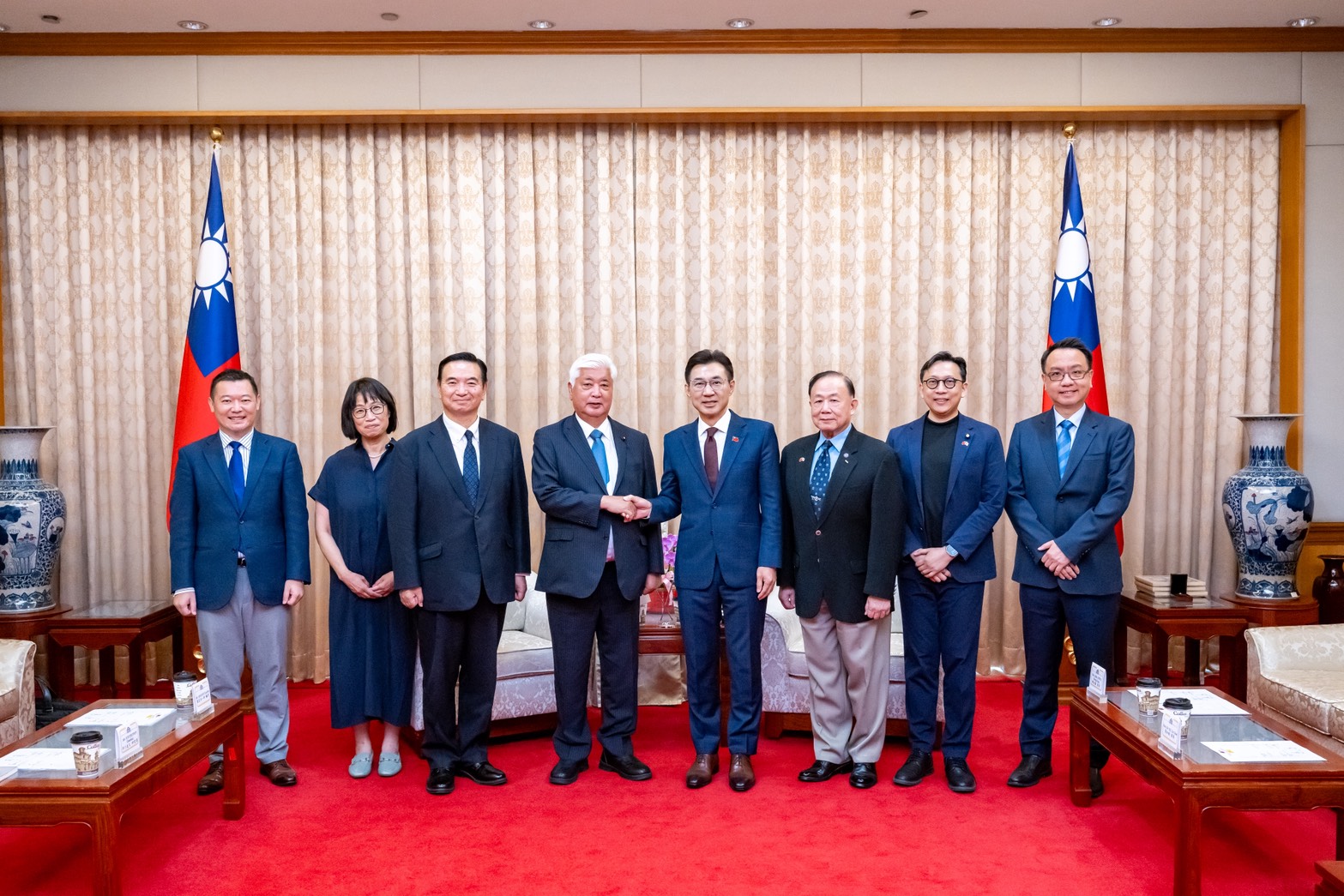
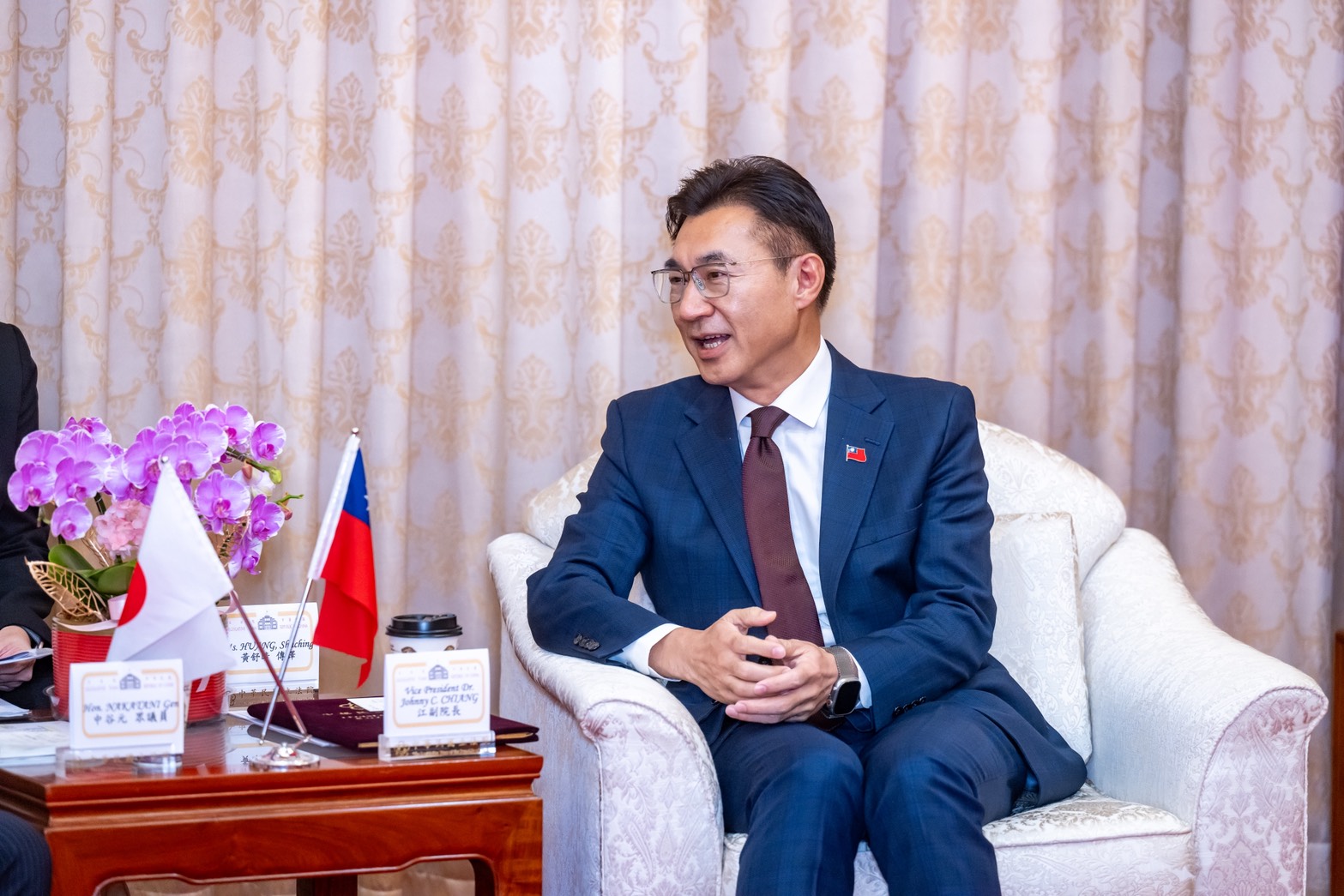
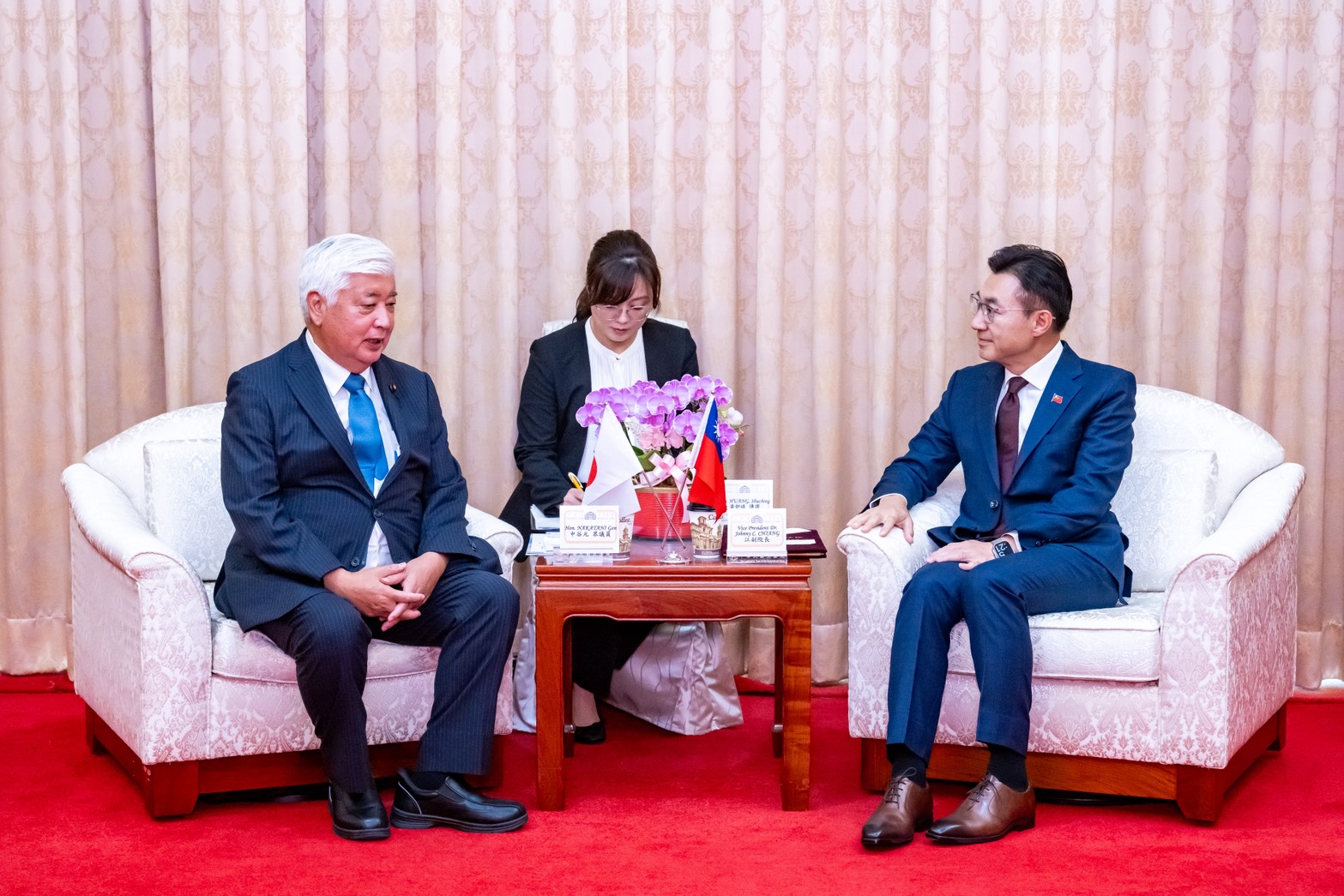
On the afternoon of August 31, Legislative Yuan Vice President Dr. Johnny C. Chiang (江啟臣), accompanied by KMT Legislators Adm. Chen Yeong-Kang and Dr. Ko Ju-Chun, as well as Dr. Li Da-Jung, Director of the Graduate Institute of International Affairs and Strategic Studies, Tamkang University, received a four-member delegation led by Japanese Liberal Democratic Party (LDP) House of Representatives member Nakatani Gen.
Vice President Chiang first extended a warm welcome to Representative Nakatani and his delegation. He noted that the two sides had met just the previous week at the welcome dinner for the Asian-Pacific Parliamentarians’ Union (APPU) meetings in Tokyo, and said it was a pleasure to meet again in Taiwan so soon. Vice President Chiang noted that Representative Nakatani has extensive political experience and has held a number of senior positions, with a longstanding focus on defense, security, and regional strategy. During his tenure as Minister of Defense in 2025, Nakatani repeatedly underscored the importance of peace and stability across the Taiwan Strait to the security and prosperity of the international community. His continued, concrete support for Taiwan, Vice President Chiang said, fully demonstrates the deep friendship between Taiwan and Japan.
Vice President Chiang further noted that, amid rapid geopolitical changes and an increasingly complex security environment in the Indo-Pacific, Taiwan and Japan are closely connected by geography, shared security concerns, and democratic values. Maintaining regional peace, security, and stability therefore requires deeper exchanges and cooperation between the two sides. Given Representative Nakatani’s longstanding involvement in defense and security affairs and his wealth of policy experience, Vice President Chiang said he hoped to draw on his insights during the meeting and explore further possibilities for Taiwan-Japan cooperation.
Turning to Taiwan-Japan relations, Vice President Chiang said that people-to-people exchanges have always formed the most significant foundation of bilateral ties. In 2025, Taiwanese visits to Japan reached 6.76 million, while the total two-way visits exceeded 8.24 million, demonstrating the close ties between the peoples of Taiwan and Japan. Regarding parliamentary exchanges, Vice President Chiang noted that he has visited Japan three times since assuming office. To date, the 11th Legislative Yuan has received 55 Japanese delegations, with delegation members making a combined 1,371 visits, including 20 delegations of National Diet members. These figures, he said, demonstrate the frequent parliamentary exchanges between Taiwan and Japan. He welcomed friends from all sectors of Japanese society to visit Taiwan more often and help foster an even broader range of cooperation.
Representative Nakatani thanked Vice President Chiang, the legislators, and the scholar present for taking the time to receive the delegation. He said that as the security environment in the Indo-Pacific becomes increasingly complex, Japan is paying close attention to regional peace and stability and continues to review its security policies. These efforts include improving the treatment of Japan Self-Defense Forces personnel, promoting the use of emerging technologies such as drones, and strengthening overall defense capabilities. He also emphasized the importance of the Japan-U.S. alliance and cooperation with regional partners, noting that peace and stability along the First Island Chain are critical to overall security. All parties, he said, should heighten security awareness and continue to deepen communication and cooperation in information sharing.
Representative Nakatani also referred to remarks he made earlier this month while attending the Ketagalan Forum: 2026 Indo-Pacific Security Dialogue in Taiwan. He noted that, in the face of increasingly complex security challenges confronting the international community, it is essential to safeguard democracy, freedom, and an international order underpinned by international law. He added that Japan would continue to strengthen its security policies and intelligence capabilities and make every effort to maintain regional peace and stability. Taiwan and Japan each possess strengths in different fields, he said, expressing hope that the two sides would continue to deepen exchanges and learn from one another.
During the exchange, Legislator Chen suggested that Taiwan and Japan could further strengthen exchanges in strategic education and intelligence. He expressed hope that by reinforcing existing channels of communication, the two sides could more promptly obtain and share information on regional developments, thereby helping to reduce the risks of miscalculation. More timely and comprehensive information exchanges, he added, would further enhance both sides’ understanding of the regional situation and strengthen bilateral cooperation.
Legislator Ko said Taiwan and Japan should deepen cooperation in information technology (IT), artificial intelligence (AI), and cybersecurity. Japan has strengths in areas such as robotic motors, multi-model collaboration, and energy technologies including small-scale nuclear power, while Taiwan has advantages in cybersecurity, drones, and AI components. He expressed hope that the two sides could build a closer technology and security partnership and combine their respective strengths, jointly enhancing national and regional security.
The two sides also exchanged views on a broad range of issues, including peace and stability across the Taiwan Strait, regional security, defense policy, and technology cooperation. The meeting lasted approximately 45 minutes and was conducted in a warm and cordial atmosphere. It concluded successfully with an exchange of commemorative gifts and a group photograph. (2026/08/31)